In Telangana, TRS is undoubtedly the dominant party. It was the first party formed with the single-point agenda of bifurcating Andhra Pradesh and creating Telangana. The party cited lack of development, disproportionate allocation of resources and employment, and differences in culture. TRS’s spearheading of the final Telangana Movement was ultimately successful in 2014, which elevated them to a much higher, distinct level, separate from other parties who also campaigned for separate statehood – TRS obtained a paternal image in the state.
In the first assembly elections, they won 63 out of 119 seats. Over the next 4 years, they poached several MLAs from different parties. TDP was virtually extinguished by this exercise, and independent candidates also were swept out. In the 2018 elections, they won 88 seats, but by 2022, they have already poached another 15 MLAs to bring them to a grand total of 103. They are a super-majority government, with strongholds in every region of Telangana. MLAs from other parties felt compelled to join the party so their assemblies also witnessed fast development, as was promised by the TRS government. So far, BJP and AIMIM were the only 2 parties from which elected MLAs have never defected to TRS.
TRS, in its 8 years of governance, has focused on appeasing varied voter bases by means of welfare schemes. This has led to 2 things – rapid development in many sectors – something which could not be attained in united Andhra Pradesh, and large voter groups who pledge loyalty to TRS. However, TRS has been inefficient in the delivery of many schemes – Double Bedroom Housing, for instance. The government also takes controversial decisions like GO 317 which alienates significant groups. TRS has not tapped into some key areas – employment is the biggest one of them.
TRS has several weak areas besides their inefficiencies, including
- The feudal, nepotistic, corrupt conduct of KCR (especially evident in the cabinet – 62% is Upper Caste, only 11% women)
- The promotion of caste-based occupations – eg distribution of sheep & goats to Golla Kuruma communities
- The unjustified public spending (eg Rythu Bandhu which only benefits landowners, construction of new secretariat, etc)
While TDP may have diminished in the state completely, and AIMIM is unlikely to expand its reach beyond Hyderabad, TRS faces competition from 2 parties mainly – INC and BJP. INC is stronger in Southern Telangana (this regional bastion has been consistent for a long time) and BJP is stronger in North (evidenced by recent wins in Lok Sabha) and urban areas of GHMC (evidenced by recent wins in the corporation and generally due to BJP’s appeal in urban areas). Although TRS has only seen growth over the years, its future is uncertain. Elimination of multiple oppositions would turn the elections bipolar or tripolar, which would mean that the opposition vote would be consolidated. This would be harmful to TRS, which may face tough competition from nationally strong parties like BJP and regionally strong parties like INC.
The post 21 Years of TRS – Will It Continue to Grow, Or Begin to Fail? appeared first on Leadtech Consulting Pvt Ltd.
]]>
Many symbols define the politics of India in the 21st century, from the mighty elephant to the humble broom. Lately, we are witnessing the rise of yet another mobilizing symbol – the bulldozer.
Political moves always have consequences – some far-reaching, extending beyond the initial effects. The demolition drive at Jahangirpuri caused a commotion, disturbed the peace and serenity of the area even more (since it took place right after the Hanuman Jayanti clashes), and gained a lot of press; all being primary consequences. The secondary repercussions will be more subtle, profound, and sustaining. An intangible impact of the tangible action is inevitable.
In formal discourse, political symbols are motivated by an urge to restore legitimacy. For instance, the bulldozing seeks to eliminate land mafia in UP or demolish illegitimate constructions in Delhi; the broom seeks to sweep up corruption from the country, and so on.
However, the varying undercurrents are what ultimately guide the more prominent narratives. The undertones are unique to each symbol – some symbols have religious implications, some have moral connotations.
These symbols are designed in a way that everyone feels obligated to engage in the discourse – from opposition to governing parties, from local residents to Indian citizens all over the country, from common people to celebrities. The discourse is not one-sided or preferential – all facets are brought up and debated upon. But the result of it all is just one, politically speaking: polarization.
After all sides have had their time to express their opinions, the real effects of the symbol come to life. No stakeholder is a mere stakeholder – they all are ultimately residents, who will be eligible voters at some point in their lives. The opinions that were formed or hardened during this initial process will guide their voting behavior in the future. They will decide who comes to power and who stays powerless.
As one of India’s top political consulting firms, Leadtech has collected and analyzed data for over 17 years. Our analysts have mapped elector behavior as far back as the early independence years. The result is clear – the ones in line with the overtones associated with the symbol benefit from the symbol, no matter what the discourse brings up. Creating enmity between X and Y may be considered unnecessary and counterproductive to India’s growth, but it polarizes both sides. With reinforced beliefs, voters become increasingly preferential. They disregard other factors. Priorities change. The benefit is only derived by the party who are perceived as saviors and protectors of the larger group.
The post Bulldozing Has Only One Consequence: Voter Polarization appeared first on Leadtech Consulting Pvt Ltd.
]]> Congress was the dominant party in India post independence. For the first 25 years, they ruled without strong opposition. From the 1970s to 1990s, INC often lost power, but they always managed to come back. They were indisputable winners – with secure vote banks in every nook and corner of the country. But post 2014, their situation has only been described as “dismal”. BJP’s dominance at the Center has virtually eliminated INC from its original position. But is it all due to the BJP? Let’s explore –
- Leadership – The high command bodies of Congress (eg. Working Committee) are generally headed by Gandhi family members. Many members have never even contested elections, like Ambika Soni.
- Organizational Structure – INC has a lot of leaders, but none of them are organized. Each of them acts on their own, which is detrimental to the party. In-party dissatisfaction, voiced mainly by the G23, also makes the party look weak.
- History – INC has a long history of corruption, nepotism, and fascism – the shadow of which it still can’t escape.
- Defection – Party seniors, who have been associated with the party for a long time, are now beginning to leave the party since they no longer see benefit in this association. Another major reason for defection is lack of rewards – Jyotiraditya Scindia left because INC refused to make him the CM of MP.
- Narrative – INC’s media team is probably their biggest drawback. Their public narrative, explaining their consecutive defeats across states, is always that their message never reached the audience in the way they had intended. INC is also unable to control the media storm about Nehru, or bank upon their involvement with the independence movement. Congress still hasn’t changed their media structure.
- Behavior – INC has even begun behaving like the Opposition. Their stances are pro-minorities to distinguish themselves from BJP, but minorities are firstly not enough to win, and secondly, even these minorities aren’t totally polarized in their favor.
INC is a stubborn party with a weak foundation. Their decline is not only due to BJP, but their own cons – the range of which includes the aforementioned. Even with a strategist like Prashant Kishor on board, they are unlikely to gain back their position in the country.
The post 6 Reasons Why Congress will continue to be in Opposition for at least the next decade appeared first on Leadtech Consulting Pvt Ltd.
]]>
- Gujarat Vidhan Sabha is the unicameral legislature of the state of Gujarat, with 182 seats.
- Post independence, the area of Gujarat came under 3 states – Bombay, Saurashtra, and Kutch. Gujarat, as a state, was formed in 1962.
- From 1962 to 1995, INC had varying levels of success in this assembly, forming the government on numerous occasions.
- Their main opposition during this period kept changing, from Swatantra Party (liberalism) to INC (O) (a faction of Congress).
- INC lost in 1975 due to a strong opposition presence – most of which banded together to form a short-lived coalition government. However, in the 1980s, they revived themselves using the KHAM formula, and won 149 out of 182 seats – the highest majority in Gujarat’s history.
- However, since the late 80s, BJP began rising on the national front, especially in Gujarat, which serves as the home state for the party. In 1990, BJP could form a coalition government with Janata Dal, but the coalition broke in less than 8 months, and INC became the coalition partner.
- Since 1995, Gujarat has been a BJP bastion. BJP has won here consecutively for 6 terms.
- However, in the initial years of BJP dominance, from 1995 to 2001, due to infighting and defections, Gujarat saw 4 different Chief Ministers from 2 different parties. In the first term, BJP lost the majority in the assembly and RJP formed the government. In the second term, BJP maintained its majority but the then-incumbent CM Keshubhai Patel resigned due to ill-health, paving the way for Narendra Modi. Post that, BJP has been consistently strong.
- Likewise, the party’s vote share was in the 42% to 45% range during its initial years, but jumped to the 48% to 50% range during the Modi era (which lasted almost 13 years, until 2014 when Modi took over as PM). In the past 8 years, Gujarat has seen 3 new CM faces, including the state’s first female CM.
- However, despite a consistently high vote share, BJP’s seats have decreased progressively, from 127 seats in 2002 to 99 seats in 2017. INC is again emerging as a strong opposition face, witnessing an increase of 26 seats in the same period, mainly due to the evolution of the KHAM formula into the KHAMP formula.
Gujarat Elections Campaign 2022
Gujarat’s political future is uncertain, as the main opposition party, INC, is growing stronger. New parties like AAP are also trying to elbow their way into Gujarat politics, which may split the votes in future. The results of the upcoming 2022 Gujarat Election Campaign may surprise India.
LEADTECH has worked in 8 constituencies in the 2007, 2012, and 2017 Gujarat Legislative Assembly elections, and 2 constituencies in the 2014 and 2019 General elections in Gujarat. Leadtech is a non-partisan political consultancy, with clients from all social and political backgrounds. Over 85% of our projects have been fully successful, in which our clients win the elections by large margins. The others have witnessed a large upswing in vote shares, which resulted in close bipolar contests, even if not a win.
The post 10 Quick Facts About Gujarat Elections Campaign appeared first on Leadtech Consulting Pvt Ltd.
]]>
Indian National Congress had a stronghold over the state assembly of Gujarat since its inception in 1962, which was occasionally threatened by short-lived opposition. However, since 1995, BJP has become dominant in the state by breaking the INC winning streak.
INC had several reasons for its win. Initially, INC banked upon its historical involvement in India’s independence and its commitment to modern India’s development. They did not face stiff competition from any of the opposition parties over the years. The opposition had strongholds only over certain communities, for example, Swatantra Party was strong among rich and middle class peasants, but even these communities were not completely alienated from the INC.
In 1974, following the Nav Nirman movement, the then-incumbent Congress CM, Chimanbhai Patel had to resign. This led to a period of President’s rule, following which fresh elections were held. In 1975 elections, INC emerged as the single-largest party, but couldn’t form the government, since all the opposition parties came together. But this was followed by the National Emergency, and within a year, the dissolution of the state government. INC briefly came to power again, but it was short lived.
The 1980s saw a massive revival of the Congress, mainly due to the KHAM formula. KHAM, which stands for Kshatriyas (including Kolis), Harijans, Adivasis, and Muslims, formed the major vote bank of INC. This caste equation appealed to the already secure voter groups of INC (like SC, ST and Minorities) but also polarized the populous Koli community in INC’s favor, which formed 24% of the population. INC used reservation as a tool to garner votes from these communities. This led to INC winning the largest majority in Gujarat’s legislative history, winning 149 out of 182 seats.
1990 saw a completely different wave, as BJP was gaining prominence nationally. INC won only 33 seats, and JD formed the government in coalition with BJP. However, INC managed to bring back Chimanbhai Patel, and stayed in power. But this lasted only till 1995.
1995 onwards, INC lost its winning streak and was reduced to the status of main opposition. Their vote share has been consistent too – in the 38% to 40% range. However, INC has been progressively flipping more assembly seats – in 2002, they won 51 seats, but by 2017, they had won 77 seats. This can be credited to Hardik Patel, Jignesh Mewani, Alpesh Thakor, and Bharatsinh Solanki – who helped evolve the KHAM formula into the KHAMP formula – now inclusive of the Patels – a group previously alienated by INC.
Congress, although historically strong in the state, had lost its majority in the 90s, and could not revive it since then. However, they have a strong formula which could work in their favor, if executed right. We see evidence of this in the 2017 election results – the first time since 1995 when BJP failed to cross 100 seats. In fact, the winning margin of BJP was reduced to just 22 seats in 2017, compared to 54 seats in 2012. INC, being the main opposition, secured most of the remaining seats.
To win, INC firstly needs a credible CM face. In addition to that, they need a strong narrative, which would place them as a better alternative to BJP. They should consider targeting urban areas as well, by expanding the KHAMP formula. They must also beware of AAP, which plans to enter Gujarat politics. Most importantly, if INC wants to win, it needs to target certain assemblies in which it is strong, but loses by slim margins. In these cases, hiring a reliable political consultancy can help them win more seats and secure a majority in the upcoming Gujarat Assembly Elections 2022.
Leadtech is a political advisory firm with 15 years of experience in Gujarat legislative and parliamentary elections. 85% of our clients have won with thumping majorities in their constituencies, and the remaining have seen substantial upswing in their vote share. Contact us now to find out more.
The post Can Congress Win Gujarat Assembly Election 2022? appeared first on Leadtech Consulting Pvt Ltd.
]]>
Political parties and elections play a significant role in the development of a country. With the increase in awareness amongst the citizens, it has become important for the political parties to make well-suited strategies to win the elections.
But, one challenge the political party can face here is the lack of information about the voters. Having no to minimal detail about the voter can be a constraint in building winning strategies. In this case, you can take the help of the voter list.
As voter list has information about the potential voters, you can build your strategies around it. Having information related to the voters can help you stay ahead of the opposition. Continue reading about the importance of voter list and how we can help.
Importance of Voter List
A voter list is the list of people eligible for voting in a constituency. The voter list is updated from time to time through proper research and analysis. Every constituency has its voter lists. It has information about the people who can cast their votes. Also, it is essential and forbids any illegal practice.
Apart from it, the voter list is an essential tool for the political parties in India. It contains all the information, interests, and gender of the voter. Through these details, you can build a winning election strategy. It will also help in the preparation of the manifesto.
How can LEADTECH Help?

LEADTECH is a political campaign company in India. We are a leading political consulting company. We can help you to analyze the political insights and make a winning strategy around them. Having been in the business for more than 12 years, we help our clients to achieve their goals and eventually win the elections.
Our main mission is to provide tension-free services to our clients. Connect with us to download the voter list, for 2021 and 2022.
Purchase and Download Voter list in excel format for Various Indian States
| S No. | State | S No. | State |
|---|---|---|---|
| 1 | Download voter list 2021 | 3 | Download voter list 2022 |
| 2 | Download voter list Delhi | 4 | Download voter list uttar pradesh |
If you want to download voter list in excel format, then you must contact us at our contact number. We will provide you updated voter list of each and every constituency.
Contact No : 0124-411-3384 || Email Id : [email protected]
The post Download Voter List 2022 appeared first on Leadtech Consulting Pvt Ltd.
]]>
UP Election 2022
A state in northern India, Uttar Pradesh has always been a significant political state of the country. After the heated stir in Punjab Congress, it will be interesting to watch political leaders’ new marketing tactics in UP Elections, 2022. The major parties contesting in UP elections in 2022 include Bhartiya Janata Party (BJP), the Samajwadi Party (SP), the Bahujan Samaj Party (BSP), and the Congress.
BJP has completed its first term in Uttar Pradesh after it won the previous assembly elections. Many people are looking for AAP’s comeback in the 2022 elections to be conducted in the year 2022. Many people are confused about how the Uttar Pradesh elections will work.
The panchayat elections were seen as a semi-final for the assembly elections as they provided an idea about the ground situation. SP says its supported candidates performed extremely well as people don’t like the current government.
But, the BJP claims it has won more seats than it did in the year 2015. The polls didn’t get contested on party symbols, but candidates represented a political party.
While the BJP chief minister Yogi Adityanath will project his achievements, the opposition will highlight his shortcomings. They are likely to target the UP government on the mishandled COVID-19, and the BJP is expected to counter the massive decrease in such cases recently.
With the COVID-19 deterioration in the year, all eyes are glued towards the 2022 assembly polls. It’ll be interesting to watch how the ruling party will handle the negative impact because of the ongoing farmer’s protest against the Center’s new agricultural reforms.
While the BJP is sure that it will win more seats than in 2017, the voters tend to disagree because of incompetence during COVID-19.
Will COVID-19 Have an Influence On Assembly Poll Results?
BJP said it can’t get blamed because of the natural phenomenon which prevailed worldwide. However, the opposition states that people didn’t die because of COVID but because the government mismanaged the situation.
The voters of UP have been seen voting for alliances, caste, and religion. So, it’ll be an interesting thing to watch whether people get influenced by COVID-19 or not.
Are all the Parties Prepared for UP Elections 2022?
With not even a year left for the elections, observers say political parties have already started making plans. They have already started to plan the election campaigns. As every contesting party knows the elections will be competitive, they have started preparing agendas to work around and achieve their goals.
What Do the Experts Have to Say?
The experts believe that the BJP government’s image got a bit dented because of the COVID-19 situation. And they also believe that Akhilesh Yadav has the upper hand as people still haven’t forgotten the development work done on his part.
Because of the previous development, Akhilesh has still considered a tough competition for the BJP. His image is strong, and he can certainly be fierce competition in the UP Elections, 2022.
The first UP Assembly election was held in 1951-52, where Congress captured 388 seats.
Past Scenarios about UP Elections
2017: BJP Wins Around 320 Seats in UP
Even after having the push from Congress, CM Akhilesh Yadav failed to win seats. The powerful political campaign led by the BJP caused hurdles, and ultimately Akhilesh’s cycle got punctured. BJP saw a massive rise in the votes since 2012 and came into power.
2012: UP Gets its Youngest CM- Akhilesh Yadav
Mayawati went to the 2012 UP Elections after completing her tenure as the CM, and she became the first CM to complete her full term. But, UP’s voters weren’t impressed by her and voted her out in the election.
Samajwadi Party came into the picture, and Akhilesh Yadav became the youngest CM of UP. However, he faced quite a backlash but was able to withstand the storm.
2007: Track-Breaking Election
The Uttar Pradesh Assembly election of 2007 was a track breaker election as Mayawati won the elections. She became the first CM to complete her tenure. But, she was voted out by the citizens in 2012.
1989-2007: UP Saw a CM of 48 Hours
VP Singh’s Janata Dal came out as the single largest party in 1989. The government was formed with help from BJP, and Mulayam Singh Yadav (a minister in the Janata government) became the Chief Minister.
A not long time passed when Mandal and Ayodhya took center stage in UP’s politics in elections. The OBC, Dalits, and Muslims were deemed as en-bloc voting communities.
Dalit and OBC got formed in 1993 as BSP’s Mayawati and SP’s Mulayam Singh Yadav came together. The tie-up wasn’t long-lasting. In 1995, Mayawati joined hands with BJP and became the first Dalit Chief Minister of Uttar Pradesh.
Years from 1989 to 2007 were unstable were 10 Chief Ministers got a witness and three President’s Rule. Jagdambika Pal only lasted for 48 hours as the CM of UP.
1980-88: Congress Replaced the CMs
Assembly elections were held in 1980 where Congress got 309 out of 425 seats. The Raja of Manda, Vishwanath Pratap Singh, became the Chief Minister. However, Congress didn’t stop its practice and continued replacing the Chief Ministers.
These eight years were full of ups and downs, and Uttar Pradesh saw at least six CMs before VP Singh revolted.
1977-80: Janata Experiment
The Janata Party was able to win more seats because of the anti-Indira Gandhi wave. The Janata Party won the majority in Lok Sabha, and all the state Assemblies were dissolved where Congress was in the majority.
Fresh elections were held in Uttar Pradesh. The Janata Party got 352 seats out of 425 Assembly seats in Uttar Pradesh. Ram Naresh Yadav became the CM, and the Janata Party found another candidate in Banarasi Das in two years. However, the Janata experiment failed in three years.
Elections were held in 1980 for the Lok Sabha, where Indira Gandhi came into power, and she got the power to dissolve the Janata Party government in the states.
1970-77: An Uncertain Period
A fresh election was held in 1969. The Congress didn’t make it to the majority by 2 seats. Congress won 211 out of the 425- seat Assembly. Jana Sangh got 49 seats, and Charan Singh’s BKD remained victorious on 98 seats.
In the next 8 years, Uttar Pradesh got to see four sessions of President’s Rule and six Chief Ministers, which included Charan Singh. Charan Singh remained in the office for over nine months.
1967: First Non-Congress CM
The Chief Minister’s Office saw its first change in Uttar Pradesh, where Congress couldn’t win a majority for the first time.
An alliance was formed between Bharatiya Kranti Dal of Jat Leader Charan Singh, Praja Socialist Party, Jana Sangh, CPI(M), Swatantra Party, and the Republican Party of India. A total of 22 Independent MLAs provided support to the alliance. It was here when Charan Singh got on the chair of Chief Minister.
The government of Charan Singh didn’t even rule for one year, and the Assembly got dissolved only after one year of the President’s Rule.
1952-1967: 5 Chief Ministers
UP got 5 Chief ministers in the period from 1952 to 1967. Govind Ballabh Pant became the first CM. After this, Sampuranand became the next CM. The Congress didn’t stop changing its Chief Ministers.
Now, moving forward to more details about the UP Elections which are going to be held in 2022.
UP Elections Prediction 2022
Uttar Pradesh has provided nine prime ministers to India. Most of the experts have predicted an easy win for BJP in the UP Elections, 2022. It is said that the party is expected to win 259 to 267 seats which will be followed by the SP party. Congress was the center of India before the 2014 general elections. Congress suffered a major shock after the 2014 elections.
UP Elections Poll Survey, 2022
Most parties have already formed alliances, and SP and Congress might forge associations with smaller parties to increase their chances to win more constituencies. However, the Mayawati party has been told to go alone and form no associations with other parties so far.
Experts consider that a planned association between SP and Congress can be fruitful for both parties. However, they advise a formal alliance. But, SP has shown its disinterest to align with Congress as the former has only 7 MLAs present in the state. However, people who are searching for an alternative to the BJP are considered to choose Congress or SP.
Many people are looking forward to the approaching UP Elections, 2022. Surveys are being conducted to see the people’s interest. The 2022 elections are considered the turning point for the AAP. People are seeing AAP as a great alternative in Congress-led states after its downfall in Punjab.
The post How have the People of Uttar Pradesh Voted? appeared first on Leadtech Consulting Pvt Ltd.
]]>The ongoing Covid-19 Pandemic has posed unprecedented challenges in our lives. The effects of demonetization, mismanagement of covid-19 in many parts of India, Job crisis and the low number of sitting in the parliament where vital issues are being discussed and debated and above all the role of opposition parties in raising the voice of voiceless people are the major cause of concern. The recent developments in Indian Electoral Politics have changed the narratives and our perspectives too about the style of leadership, hereditary nature of Indian leadership, the role of coherent ideology, the manner in which decisions being made and implemented and political parties approach towards reaching the various social groups, etc. As many political experts say that despite having declined in electoral politics since 2014, one cannot imagine the Indian politics without the Congress party and it still plays a pivot role.
This article has focused on the current state of Indian politics and the speedy decline of the Congress party from National politics particularly after 2014 and the possible ways forward.
Glimpses of INC performance in the general election from 2004 to 2019
From 2004 to 2014 the congress party with help of other regional parties was able to form a govt. by defeating the National Democratic Alliance (NDA) led by the BJP.

However, there are many theories, as propagated by political experts, around the decline of the Congress party. Many political pundits have argued that it has created a space for political entrepreneurs that led to various corruption scams such as the earlier Bofors scam, 2G scam, Sahara Scam, and poor governance system while others believed that lack of charismatic leadership, connectivity with masses, and social engineering of caste groups, etc. Many political observers even including ex-congress leaders (now in BJP) have mentioned that their personal growth has stagnated and decision-making process has been hijacked by a few veteran leaders that led to suffocation. For instance, referring to Rahul Gandhi, “Our once and future king” tweeted by a senior leader of the Congress party on the death anniversary of Rajiv Gandhi. What does it show? Do we believe in democracy or chamchagiri? While on other hand pursuing president Pranab Mukherjee and giving a warm and emotional farewells to senior leader Gulan Nabi Azad was another political gesture of BJP.
Politicians Who Thought to Left the INC
- Milind Deora who thought to left the INC as INC didn’t like his idea on Article 370. Since he supported the BJP’s strong decision on the suspension of Article 370 but congress party simply opposed his ideological stand.
- Sachin Pilot was another politician who was quite in news for going against the INC. The simple reason going against the party in Rajasthan was all hard work and Party campaigning was done by him but CM candidature offered to Ashok Gahlot.
All is not well in the Congress Party
Here is the list of prominent leaders who were earlier in the congress party but now have left and joined BJP as if
- Jitin Prasad
- Jyotiraditya Scindia
- Chaudhary Birender Singh
- Rita Bahuguna Joshi
- Tom Vedakkan and the list goes on.
Many political scientists believe that lack of consistency in policy decisions and policy actions, no coherent ideological commitment, growing Left-Congress synergy, and of course lack of personal growth of leaders, etc. are the possible reasons. For instance, Left-Congress Synergy has been unproductive as well as confusing for common party workers. In West Bengal they (Congress and Left together) fought election against Mamta Banerjee but what about in Kerala where Congress and Left parties were contested against each other.
Way forward
In the 2019 general election Rahul Gandhi was defeated by Smriti Irani in the Amethi Lok Sabha seat but manage to get elected from Wayanad (Kerala). In August 2020, G-23 i.e. 23 senior leaders of the Congress party have expressed their concerns to interim party Chief Sonia Gandhi. They have expressed their views on the poor performance of the Congress party in two consecutive general elections, bringing all structural reforms, self-introspection, and strategizing for upcoming elections. Even the post of Congress party president is still waiting for a full-time president. It was a clear political gesture to the congress party to rethink or purnavichar, restructure its party composition and bring fresh and young people to the party. But as being acknowledged by BJP-RSS senior leaders that still the congress party is the biggest challenger to the BJP party despite having a continuous decline. It is because it has managed to secure approx. 20% of total votes in two general elections i.e. 2014 and 2019 while the rest of the parties (excluding BJP) were not able to cross double-digit. It means at the bottom side it has maintained the status quo. Any increase in this percentage will surely affect the BJP vote share and would have led to a coalition government as well. Gandhi’s Family is still key to the Congress party that’s why Modi-Shah led BJP party keeps on attacking Gandhi Family. The Congress party needs to focus on
- To understand the changing nature of young voters, their aspirations and demography dividend and do all needful accordingly
- Innovative political Strategies and to communicate the masses at a large scale by judicious utilization of ICT platform.
- To provide some paces to local/regional parties and help them to form stable government where the Congress party is not in majority. Do not become power-hungry but adaptive according to the prevailing political scenario.
- Of course restructure its political organization or even vacating various seats as well otherwise many more leaders are waiting to join the BJP.
The post Congress Free India: How Far From Reality appeared first on Leadtech Consulting Pvt Ltd.
]]>The outbreak of Covid-19 has posed a serious threat to the Nation with varied impacts from region to region but politics has always been its epicenter. Ongoing Pandemic and its mismanagement has deep- rooted consequences among the scheduled castes and scheduled tribes, women and other vulnerable sections of the society that has raised the issue of social justice. All political parties are gearing up for the upcoming Uttar Pradesh Assembly election 2022. A common phenomenon that run through in all political parties’ manifesto is “social Justice”. BSP claims to be a party of Bahujan and champion of social justice but recent developments within the party are indicating that all is not well.
Recently many prominent leaders have left the BSP party and joined either SP or BJP and they made allegations of her bureaucratic style of working, monopolization, unapproachable, arrogance, and not upholding the legacy of Kanshiram Ji. As these leaders said “kab kisko hata diya jaaye kya pata”. For instance, MLA Aslam Rashid, in an interview, mentioned that 11 BSP MLA trying to form their own party and would seek support from others as well. In the past R. K Chaudhary, Indrajeet Saroj, Naseemuddin Siddiquie, Swami Prasad Maurya and Brijesh Pathak etc. have left the BSP party.
Source: Trivedi Centre for Political Data
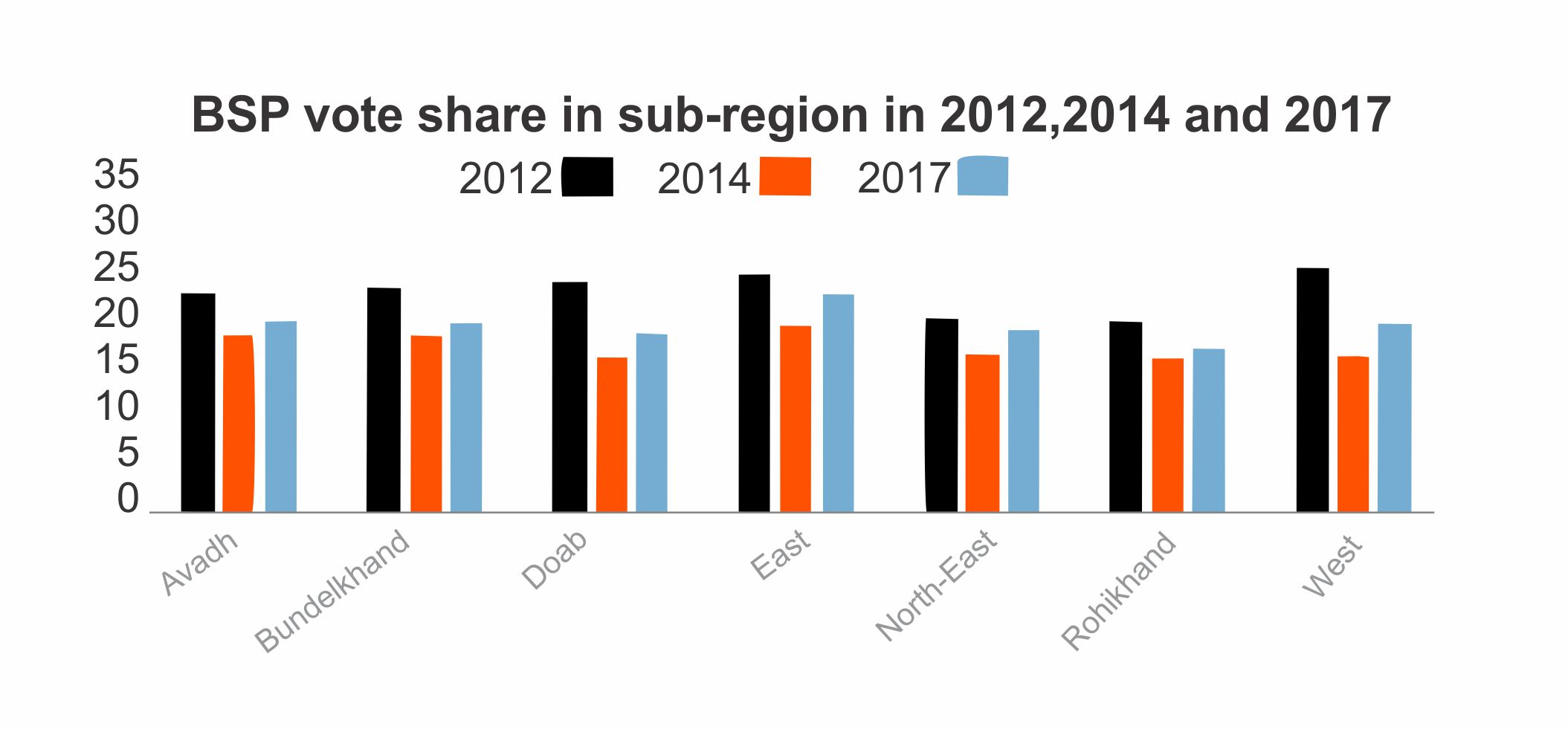
The above graph shows the trend of constant decline in the voting percentage of the BSP party but still, the BSP has managed to secure 20% of votes in all consecutive assembly elections. Overall the BSP’s performance has improved but each constituency-wise it has lost its ground considerably. The rise of young Dalits icon Chandra Shekhar Azad and his connectivity with common masses (predominantly Dalit youths), using all means of communication, raising the issue of social justice, and visiting places where atrocities against Dalits being reported and so on have made him a key player in upcoming U.P state assembly election 2022.
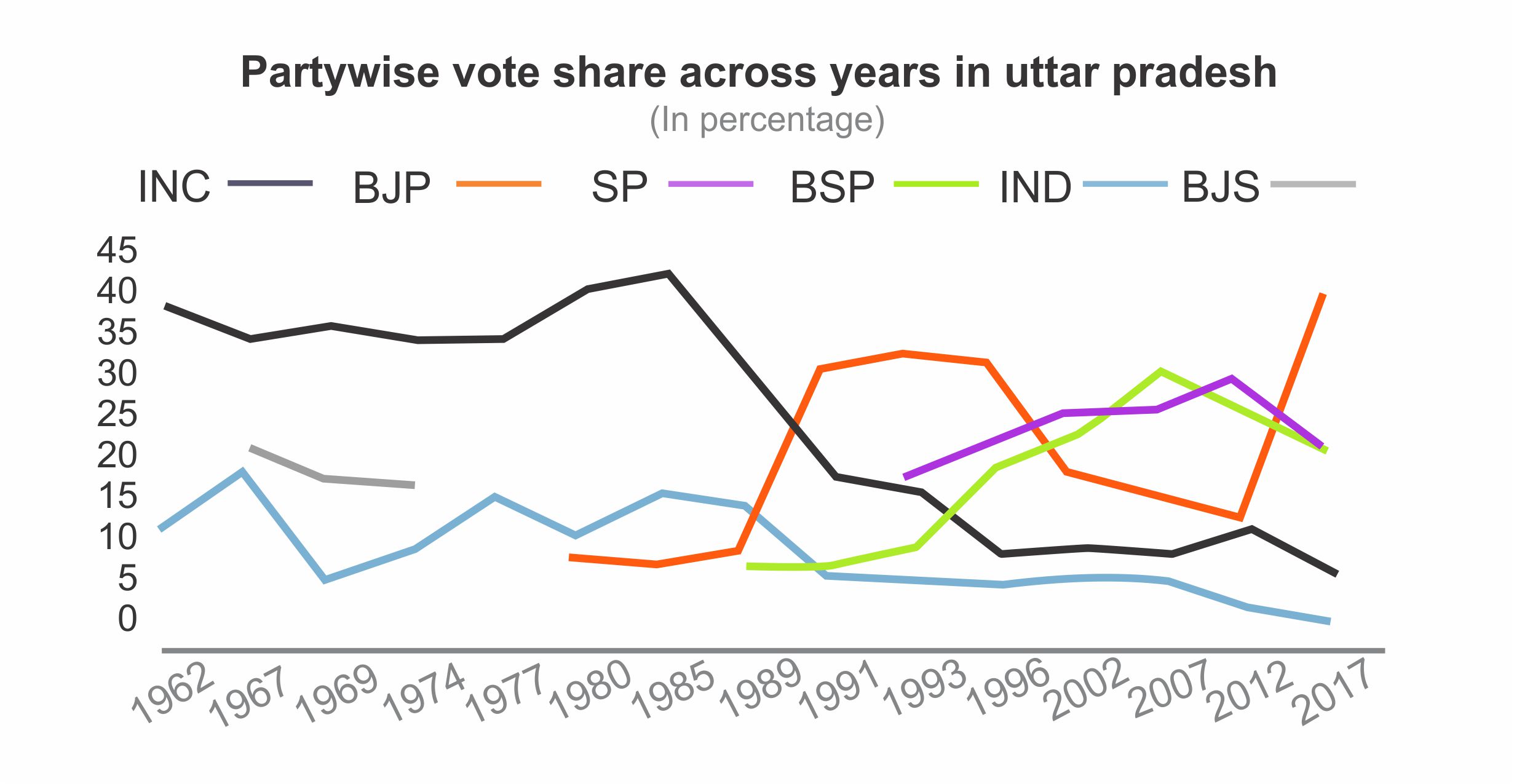
Source: Trivedi Centre for Political Data
As above-trend shows that the BJP party has been successfully transferred SC and OBC votes considerably due to its social engineering strategy, by capturing the political vacuum created by other political parties, making alliances with small regional parties giving them tickets and portfolios, and also targeting Dalits and MBC i.e. most backward castes such as Mallah, Bind, Rajbhar, Chauhan, Kumhar, Luhar, etc.
The vision of Kanshi ram was to put forward the idea of identity-based representational space for the communities in the Indian Political system and absolute equality, opposed to dynastic control over the party and opportunistic politics. Sadly Mayawati did it all that being avoided by the Kanshi Ram and consequently, BSP has lost the elections and also reducing vote bank particularly among the Balmikis who were traditionally associated with BSP but now shifting to BJP considerably. Therefore BSP requires immediate self-introspection, building good teams of youths, the delegation of power, decentralization, and democratization in the working of party, building trust among the party workers, and gain the faith of common voters.
The post The Rise and Fall of India’s Dalit Queen. appeared first on Leadtech Consulting Pvt Ltd.
]]>