Categories
Election management software Software Services

Election Management Software India: Voter Data, Booth Tracking and What to Check

Ask any campaign manager and they’ll say they run on data. Then you walk into the war room and find a voter list PDF, three WhatsApp groups nobody has muted, and one booth president who “knows everyone.” He probably does, too. Right up until he gets dengue two days before polling, which we have actually seen happen.

For the 2024 Lok Sabha election the Election Commission of India set up 10,52,664 polling stations. You can’t run that many booths off phone calls, though people try every year.

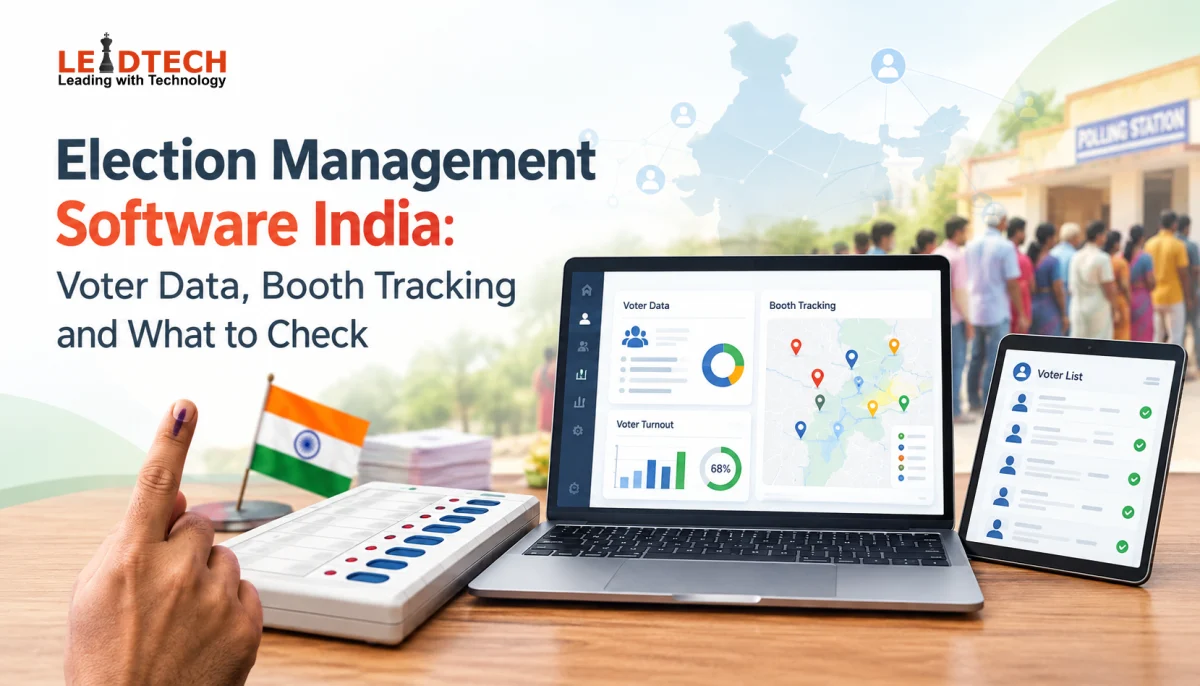
Good election management software India campaigns use pulls voter records, booth assignments, door-to-door feedback and polling-day tracking into one place. I’ll be straight with you: it doesn’t win seats. Good booth teams win seats, and the software mostly stops them losing track of things.

What Is Election Management Software?

Think of it as your constituency’s voter list, except your team can actually do things with it. You search someone by name or EPIC number, tag them by booth, locality or age, hand them to a volunteer and log the visit. All of it shows up on a dashboard in the war room.

The decent tools work on a phone, in Hindi or whatever the local language is, on a patchy signal. We once had village workers quietly stop using an app because it took about forty seconds to open, and headquarters spent a week wondering why the updates had dried up. Nobody complained. They just went back to WhatsApp.

So check load time first. Before the features, before the price.

Why Booth-Level Data Matters More in 2026

Close seats get decided at the booth. The ECI’s Atlas 2024 puts registered electors for the 2024 Lok Sabha polls at 97,97,51,847, averaging 931 per polling station, up from 879 in 2019. Nobody keeps that in their head.

The rolls don’t sit still either. When the ECI announced Kerala’s 2026 assembly schedule in March, Goodreturns reported 2,71,06,059 registered voters. By polling day on April 9, Kerala Kaumudi had it at 2,71,42,952. That’s tens of thousands of names moving in a few weeks after a Special Intensive Revision. If your list is from January, some volunteers will be knocking on doors of people who now live in Bengaluru.

Booth sizes are being capped too. For Kerala’s 2026 polls the ECI capped stations at 1,200 electors and announced 30,471 of them, roughly 5,000 of them new (Onmanorama and Goodreturns, March 2026). Every new one needs an in-charge who actually knows the lane.

Election Management Software India Features That Matter

If budget’s tight, spend on voter search, booth mapping and the canvassing app.

Voter list search and segmentation. You load the electoral roll, clean it and make it searchable. With decent segmentation you can pull every first-time voter in booths 40 to 65 in seconds. With bad segmentation you get a 3-lakh-row Excel file and a long evening. The cleaning eats the time: duplicate names, wrong house numbers, the occasional voter who appears in two booths at once.

Booth mapping and polling-day tracking. Every booth gets an in-charge, a household list and a target. On polling day workers mark who has voted, and by about 11 am the war room can see which booths are falling behind and send people over. In a tight race this is the feature I’d pay for even if the rest were rubbish.

Door-to-door canvassing app. Workers record each visit: who was home, what they complained about, which way the family lean s. Keep the form shorter than you think. People will answer five questions on a doorstep. Give them fifteen and they’ll skip half or tap whatever is nearest their thumb.

Funny thing, this part isn’t really political. Plenty of CSR evaluation companies India works with run village impact surveys on almost the same setup: short mobile forms, GPS on every visit, offline sync. Different questions, same tired surveyors guessing answers.

Social media and grievance tracking. In most campaigns, political social media campaign management sits with a digital team that barely talks to the ground team, and it drives us a bit mad. Better tools tie posts and complaints to the same constituency map, so a Facebook complaint about a broken road in ward 12 lands with the booth team that can walk over and look.

War room dashboard. Our rough test: can the candidate make sense of it in two minutes, between meetings, on a phone? If not, there’s too much on it.

Spreadsheets and WhatsApp vs Software

Plenty of campaigns still run on Excel and WhatsApp, and for a ward election that’s honestly fine. At assembly level it starts to creak. Search goes first: you open one file, then another, then ask someone on WhatsApp which file has booth 52. Booth assignments go next, because nobody updates the master sheet after the roll changes.

Field updates are the real mess. WhatsApp gives you photos, voice notes and a lot of “done ji” messages, none with a booth number attached. A proper form turns each visit into a row you can count.

To be fair, spreadsheets cost almost nothing upfront, while software means a licence and a few days lost to training. We’d still argue the spreadsheet bill turns up later, around 11 am on polling day, when nobody can say which booths are behind. A spreadsheet also ends up with whoever it’s forwarded to, and it always gets forwarded.

ECI Rules on AI Content in Campaigns

If the software has a social media module, it has to fit the ECI’s rules on synthetic content. Storyboard18 reported that on May 6, 2024, following directions from the Delhi High Court, the ECI told parties to pull deepfakes within three hours of notification. In October 2025, ahead of the Bihar polls, it added mandatory labels and asked parties to keep records of AI material with creator details and timestamps.

For the 2026 assembly elections in Assam, Kerala, Tamil Nadu, Puducherry and West Bengal, MediaNama’s April 2026 report says platforms had to act on flagged unlawful or misleading content within three hours, and parties and candidates had to label AI-altered material as “AI-Generated”, “Digitally Enhanced” or “Synthetic Content”. Tamil Nadu’s Chief Electoral Officer added that the label must cover at least 10% of the display area, per the Deccan Chronicle.

These rules target parties, candidates, their representatives and platforms, not the software vendor. But if the tool makes labelling fiddly, guess who carries the risk? Ask the vendor to show how it adds labels and records who posted what. This is where political social media campaign management stops being creative and becomes compliance.

Voter Data and India’s Privacy Law

Voter phone numbers, survey answers, little notes like “leans our way”: all personal data, and your campaign is the one collecting it. The vendor shares the problem, but mostly it’s yours.

According to the Press Information Bureau, the Digital Personal Data Protection Rules, 2025 were notified on 14 November 2025, with eighteen months to phase in compliance. The heavier duties (notice and consent, breach reporting, security safeguards) start from 14 May 2027, per an Anantam IAS summary. If you’re preparing for an election in 2027 or later, plan on the full rules applying.

When we talk to election management software India vendors, we ask three things. Where is the data stored? Who can export it? What happens to it once polling’s over? Push hardest on export. It gets the vaguest answer.

How to Pick Election Management Software India Campaigns Will Actually Use

Give yourself eight to ten months before polling. Cleaning the roll alone takes weeks, and getting booth teams comfortable with an app takes longer than the candidate expects.

Before signing, put the app on the cheapest phone your booth workers carry (the demo iPhone tells you nothing) and try it with one bar of signal. Check the local language and an offline mode that syncs later.

Train in small block-level groups; videos get half-watched and forgotten. Keep access tight: a booth worker only needs their own booth. After launch, someone senior must open the dashboard daily and act on it, because workers stop sending updates the moment they sense nobody’s reading.

The mistake we see most is buying the tool a month before polls and hoping. A close second is handing it to one IT person while everyone else carries on as before. One habit helps: pick five numbers (booths covered, households visited, open complaints, active volunteers, turnout by noon) and discuss only those in the daily meeting.

Frequently Asked Questions

#wpsm_accordion_105286 .wpsm_panel-heading{
padding:0px !important;
}
#wpsm_accordion_105286 .wpsm_panel-title {
margin:0px !important;
text-transform:none !important;
line-height: 1 !important;
}
#wpsm_accordion_105286 .wpsm_panel-title a{
text-decoration:none;
overflow:hidden;
display:block;
padding:0px;
font-size: 17px !important;
font-family: Open Sans !important;
color:#000000 !important;
border-bottom:0px !important;
}

#wpsm_accordion_105286 .wpsm_panel-title a:focus {
outline: 0px !important;
}

#wpsm_accordion_105286 .wpsm_panel-title a:hover, #wpsm_accordion_105286 .wpsm_panel-title a:focus {
color:#000000 !important;
}
#wpsm_accordion_105286 .acc-a{
color: #000000 !important;
background-color:#e83c2312 !important;
border-color: #ddd;
}
#wpsm_accordion_105286 .wpsm_panel-default > .wpsm_panel-heading{
color: #000000 !important;
background-color: #e83c2312 !important;
border-color: #e83c2312 !important;
border-top-left-radius: 0px;
border-top-right-radius: 0px;
}
#wpsm_accordion_105286 .wpsm_panel-default {
border:1px solid transparent !important;
}
#wpsm_accordion_105286 {
margin-bottom: 20px;
overflow: hidden;
float: none;
width: 100%;
display: block;
}
#wpsm_accordion_105286 .ac_title_class{
display: block;
padding-top: 12px;
padding-bottom: 12px;
padding-left: 15px;
padding-right: 15px;
}
#wpsm_accordion_105286 .wpsm_panel {
overflow:hidden;
-webkit-box-shadow: 0 0px 0px rgba(0, 0, 0, .05);
box-shadow: 0 0px 0px rgba(0, 0, 0, .05);
border-radius: 4px;
}
#wpsm_accordion_105286 .wpsm_panel + .wpsm_panel {
margin-top: 5px;
}
#wpsm_accordion_105286 .wpsm_panel-body{
background-color:#ffffff !important;
color:#000000 !important;
border-top-color: #e83c2312 !important;
font-size:17px !important;
font-family: Open Sans !important;
overflow: hidden;
border: 2px solid #e83c2312 !important;
}

#wpsm_accordion_105286 .ac_open_cl_icon{
background-color:#e83c2312 !important;
color: #000000 !important;
float:right !important;
padding-top: 12px !important;
padding-bottom: 12px !important;
line-height: 1.0 !important;
padding-left: 15px !important;
padding-right: 15px !important;
display: inline-block !important;
}

Ans. It varies with seat size, number of logins and how messy your roll is. Get quotes based on booths and active users, and ask whether training and polling-day support are included or extra.

Ans. Using the software is legal. What you do with it must still sit within the Model Code of Conduct, the ECI’s social media and AI labelling rules and the DPDP Act. Stick to rolls obtained through official ECI channels, and talk to a lawyer before buying voter data from anyone else.

Ans. The better ones do, syncing when the phone regains signal. It’s the same setup many CSR evaluation companies India uses for village surveys, so ask the vendor to switch mobile data off in front of you and show it working.

function do_resize(){

var width=jQuery( ‘.wpsm_panel .wpsm_panel-body iframe’ ).width();
var height=jQuery( ‘.wpsm_panel .wpsm_panel-body iframe’ ).height();

var toggleSize = true;
jQuery(‘iframe’).animate({
width: toggleSize ? width : 640,
height: toggleSize ? height : 360
}, 250);

toggleSize = !toggleSize;
}
Categories
Election Campaigns Management

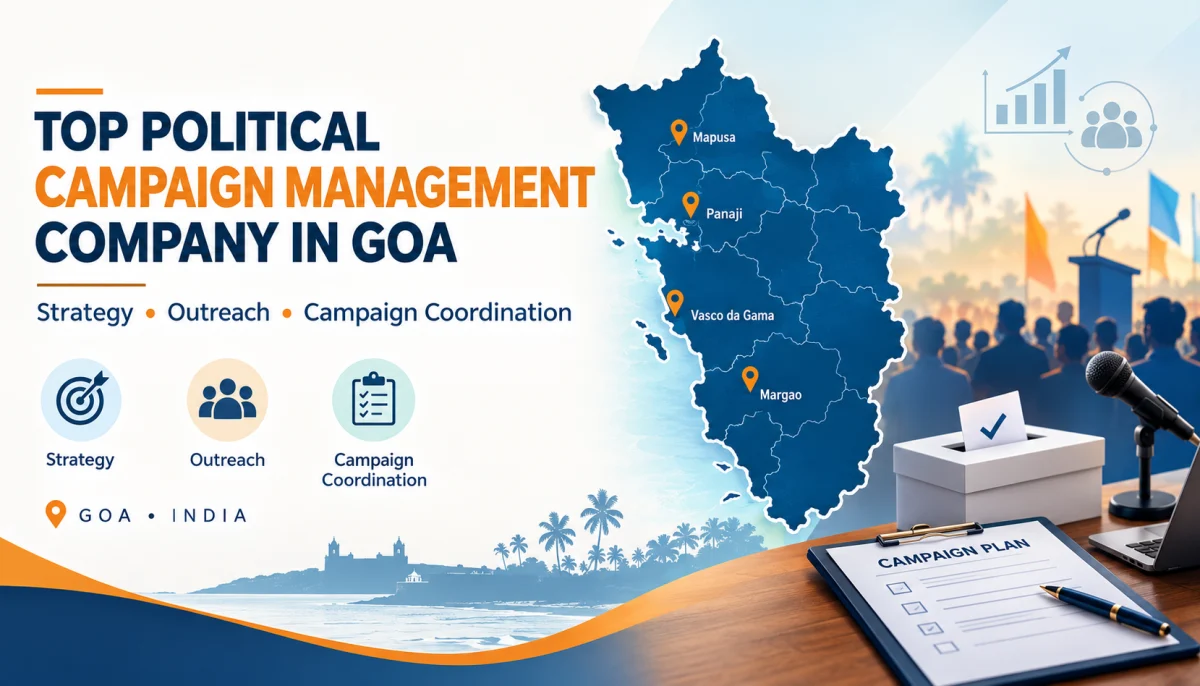
Top Political Campaign Management Company in Goa

Forty seats. A majority mark of 21. And a habit, election after election, of deciding races by a few hundred votes. That’s not dramatic license; it’s just how Goa votes. In that kind of environment, a political campaign management company stops being an optional extra and starts being the thing standing between a seat won and a seat lost by 400 ballots.

So what does one of these companies actually do? This piece walks through the research, ground teams, digital push, polling, and the mistakes that quietly cost candidates seats.

What Is a Political Campaign Management Company?

A political campaign management company is hired for the operational side of a campaign. Research, booth management, volunteer coordination, messaging, media buying, and these days, social media election management in Goa as a full workstream of its own.

The candidate is the face. Someone else decides which villages get door-to-door visits this week, which WhatsApp group hears which version of the message, and where support is quietly leaking away. That invisible second job is what these companies are built to do.

And it’s not city-only work. Goa has 40 assembly constituencies running from dense urban stretches around Panaji to hinterland seats where everybody genuinely knows everybody. I’ve seen campaigns run identical messaging across coastal Salcete and interior Sanguem and wonder why half of it fell flat.

Why Goa Needs Campaign Management Ahead of the 2027 Assembly Election

The Goa Assembly election is expected in February 2027. Chief Minister Pramod Sawant said as much in August 2026, adding that the final schedule sits with the Election Commission of India. The current Assembly was elected on 14 February 2022 and its five-year term runs out around early 2027.

Why does that matter more than a year out? Model Code of Conduct restrictions land the moment the election is announced, usually four to six weeks before polling day. Rallies, ad spend, even social media activity get harder to move once that clock starts, so the strategic work has to happen before the announcement.

Goa’s numbers back this up. In 2022, the BJP won 20 of 40 seats on 33.3% of the vote, barely up from 32.5% in 2017, yet picked up seven extra seats. Congress took 11 seats on 23.5%, down almost five points and six seats. AAP went from zero seats to two on just 6.77%, proof that a tight, well-targeted push in the right pockets beats broad but shallow name recognition. Turnout was 81.89%. Small shifts, disproportionate seat swings. That’s why constituency-level work beats a glossy state-wide strategy deck.

How a Political Campaign Management Company in Goa Works

Most engagements follow roughly the same shape. First comes baseline research: past voting patterns, community composition, local grievances, and wherever the incumbent looks weakest. Then, ideally early, an opinion poll survey across constituencies, because a real survey tells a campaign where it stands before a single rupee goes into messaging. Skip it, and you’re campaigning on assumption.

Next is message building. What does the candidate stand for, in one line a voter could repeat to a neighbour over tea? That gets tested against real people.

Then the work most people don’t see: booth-level volunteers, local coordinators, door-to-door rounds. This still wins elections in Goa. Digital hasn’t replaced it, it’s added to it. Alongside that runs social media election management, split by constituency, language (Konkani, Marathi, English) and age group. Mid-campaign, a second round of polling or honest ground feedback shows what’s landing and what’s dead weight. In the final stretch, it’s turnout drives, last-mile messaging, and staying inside Model Code of Conduct spending rules.

Key Benefits and Real Limitations

Hiring this kind of team buys concrete things. Research methods individual candidates couldn’t run alone. One structured message instead of ten from local leaders. A faster response when a rival moves or a local issue flares up. Compliance support, since spending and messaging rules in Indian elections are easy to breach without meaning to. And social media handled by someone tracking platform changes rather than, as one candidate’s aide put it to me, “my nephew who’s good with Facebook.”

The limitations don’t disappear, though. No company manufactures support that isn’t there; good management sharpens a real case, it doesn’t invent one. Digital reach still hits ceilings in parts of rural Goa, so social media can’t fully stand in for groundwork. Opinion polls carry margins of error, especially in constituencies where a few hundred voters can flip the outcome. And a properly run operation isn’t cheap. Candidates who treat the budget as an afterthought usually regret it by week two.

Core Strategies: Social Media and Opinion Polling

Social Media Election Management in Goa
Paid and organic activity across Facebook, Instagram, YouTube, and WhatsApp, run constituency by constituency rather than as one blanket push. India crossed roughly 886 million active internet users by 2024, growing 8% year-on-year, according to a joint IAMAI and Kantar report. Internet penetration reached about 70% of the population aged 15 and above, per a National Statistics Office figure referenced in late 2025. Goa ranks among the more literate and urbanised states, which usually tracks with higher digital reach, though no Goa-specific, government-sourced penetration figure was available for this piece.

Opinion Poll Survey for Goa
A pre-election survey across sample constituencies, gauging sentiment, issue priorities, and name recognition. This is not an exit poll, legally or practically. Under Section 126A of the Representation of the People Act, 1951, exit polls can’t be conducted or published during any period the Election Commission notifies, and breaching that can mean up to two years in prison or a fine. Opinion polls taken before voting don’t fall under that ban. Section 126, though, stops any “election matter,” opinion poll results included, from airing on electronic media during the 48-hour silence period before polls close. Getting this wrong is a legal problem, not an awkward correction.

Ground Canvassing vs Social Media Election Management: A Comparison

FeatureGround CanvassingSocial Media Election Management
ReachLimited by volunteer hours and geographyBroad, fast, scales across a constituency in days
Trust builtHigh, face-to-face builds it fastestModerate, hinges on content quality and consistency
Cost per contactHigher, labour-intensiveUsually lower per person reached
Targeting precisionRough, based on local knowledgeSharp, by age, language, location, interest
Speed to adjust messageSlow, needs volunteer retrainingFast, content shifts within hours
Effectiveness with older or rural votersStrongWeaker, though closing the gap as smartphone use spreads
Legal sensitivityLower, mostly local permission rulesHigher, needs compliance with ECI social media guidelines and MCC

Best Practices and Common Mistakes

Run the opinion poll survey early, not two weeks before the Model Code of Conduct lands, when it’s a formality rather than a strategy tool. Localise everything; a message that lands in Panaji can flop in Canacona. Keep social media tone consistent across platforms. Train volunteers on what they can and can’t say, especially around spending limits, because most violations are accidents. Track sentiment weekly. And budget for compliance and legal review, because that line item isn’t optional.

On the mistakes side: treating one opinion poll as gospel rather than a snapshot that ages fast. Skipping Konkani and Marathi content for English-only messaging, which quietly writes off a real share of voters. Pouring money into paid ads while under-staffing ground coordinators. Missing ECI disclosure rules for pre-poll surveys, including sponsorship and methodology, which the Press Council of India has flagged as a requirement during election periods. And waiting until the final month to build any digital presence, forgetting that trust online takes time to earn, same as offline.

Conclusion

Goa elections come down to a handful of votes in seat after seat. A political campaign management company in Goa exists so a candidate isn’t losing those votes to disorganisation, a muddled message, or a digital push that never reaches the people deciding the outcome. Ground work, social media election management, and an honest opinion poll survey in Goa are three parts of one job. With the Goa Assembly Election expected in February 2027, the research and ground-planning window is open right now. Get in touch for a constituency-level consultation and see what a properly run opinion poll survey tells you, before a single rupee goes into messaging.

Frequently Asked Questions

Ans. Yes. Pre-election opinion polls aren't banned in India. Section 126A targets exit polls specifically, and Section 126 restricts election matter, opinion poll results included, only during the 48-hour silence period right before voting ends.
Ans. It has to operate inside Election Commission rules on ad pre-certification, spending disclosure, and the Model Code of Conduct, layered on top of the usual targeting work any digital agency does. A generic marketing shop without election experience can miss these entirely, and that's not a small mistake to make mid-campaign.
Ans. No. Be wary of anyone who says otherwise. Good management improves the odds through research, organisation, and message discipline. It can't manufacture support that simply isn't there on the ground.
Ans. Yes, and Goa's own turnout numbers make the case. Turnout has stayed above 80% in recent elections, and individual seat margins are often small. Face-to-face contact still builds the kind of trust that swings a close race, even where digital reach is already high.
Categories
Political Consulting Company Political Consulting Services

5 Signs Your Campaign Needs a Political Consulting Company

Ask anyone on a losing campaign what went wrong and you will have a clear answer inside a minute. Ask the same person six weeks before polling and you get silence, or reassurance. The information existed on both occasions. What was missing the first time was a way to prove it and somebody with the data and numbers to say it out loud. A political consulting company exists to close that gap.

Table of Contents

  1. What Is a Political Consulting Company?
  2. Why This Matters More Than It Used To
  3. The 5 Signs
  4. How a Political Consulting Team Work 
  5. What You Get, and What You Give Up
  6. In-House vs Consulting Firm
  7. Bringing a Team On Board (Step-By-Step Process)
  8. Mistakes Candidates Repeat Every Cycle
  9. What 2026 Showed
  10. FAQs

What Is a Political Consulting Company?

A professional team that plans, runs and measures a campaign for a candidate, a party unit or an alliance. While you, the party, owns the decisions, the consulting team owns the research, planning and reporting.

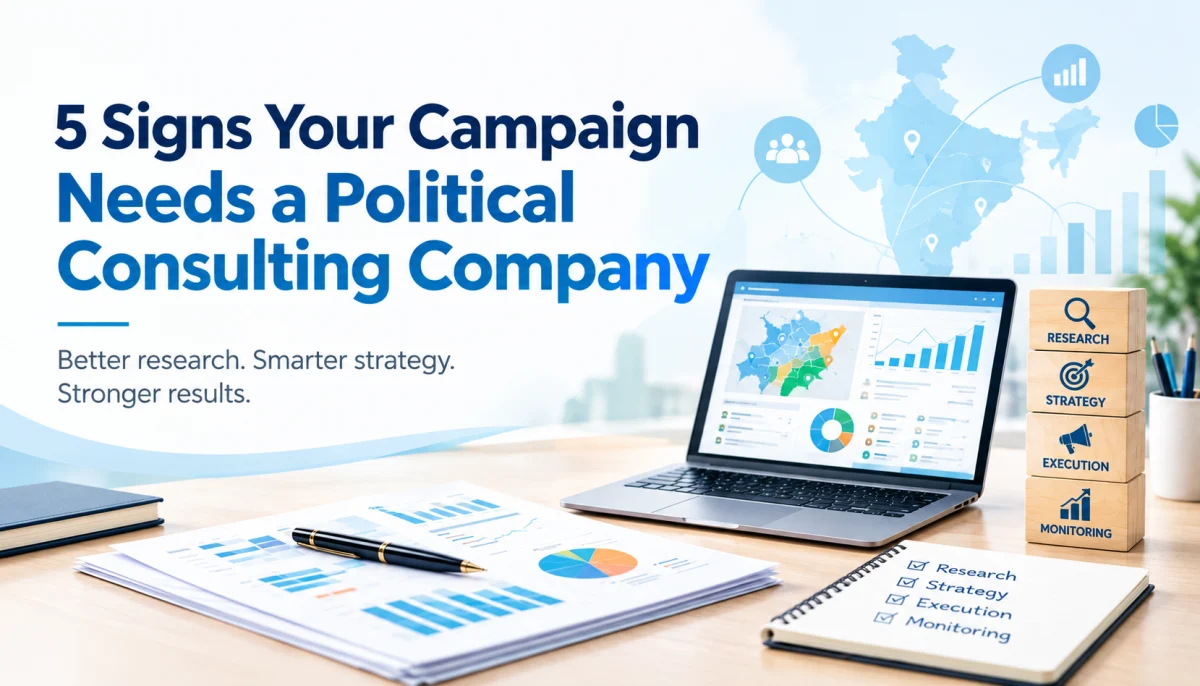
Research covers election survey work, booth level data and opponent analysis. Strategy sets your message and your target voter groups. Execution covers digital political campaigns, media handling, events and a structured door to door campaign. Monitoring is the part most campaigns skip that is checking everything weekly whether all of it is working fine.

Why This Matters More Than It Used To

Two things have changed at the same time. Winning margins have narrowed considerably, and the constituencies themselves have grown much larger than they used to be.

The 2026 assembly elections covered 824 seats across four states and one union territory, with more than 17 crore eligible voters between them. A single assembly seat in a large state now holds several lakh voters spread across a few hundred booths. Twenty years ago, a candidate with a good memory and a loyal set of workers could keep most of that in their head. That is no longer realistic.

No candidate can track a seat of that size personally, and the ones who try usually end up knowing three or four blocks very well and the rest hardly at all.

The 5 Signs

1. Everyone who briefs you wants something from you.

Your information comes from people seeking tickets, contracts or approval. None of them will be the one to tell you a block is slipping, which is exactly why an election survey exists.

2. You are buying visibility to fix a credibility problem.

High name recall with flat support means people know you and are not convinced. More hoardings and more posts will not move that number, and may harden it.

3. You cannot differentiate a busy week from a good week.

Rallies held, posts published, kilometres covered. If nothing on that list connects to a change in voter opinion, you are measuring effort instead of progress.

4. Your workers’ reports are never checked against results

Booths called strong by your team turned out weak at end time, and nobody went back to find out why. A door to door campaign that never gets checked against the count will only ever tell you what you already assumed. 

5. The campaign stops when you stop

If travel, illness or a court date pauses everything, you do not have a campaign. You have a candidate doing all the work personally, and it will not survive the final month.

How a Political Consulting Team Work  

It begins with a baseline election survey covering name recall, approval, local issues, opponent perception, and community-wise voting intention.

This data becomes a strategy document naming your target segments and the wards you must win. Execution then runs in weekly cycles, with booth teams working daily targets and digital teams pushing seat-specific content in the local language. In the final six to eight weeks persuasion is largely finished, and the work shifts to getting people who already support you physically to the booth. 

What You Get, and What You Give Up

You get:

  • Decisions made on evidence.
  • Candidate time protected and pointed at high-value activity. 
  • A door-to-door campaign you can actually audit. 
  • Audience digitally targeted by locality, language and segment. 
  • A team that keeps working when the candidate is travelling, unwell or stuck in a court date.

Now on the other side, 

Consultants cannot rescue a weak candidate, manufacture credibility that was never there, and they can do very little if you hire them three-four weeks before the voting.

You also give up some control, which candidates underestimate. A firm is only worth its fee if it can say no to you and be heard. Where disagreement gets treated as disloyalty, the firm works that out fast and starts recommending whatever you already wanted. You end up paying senior rates for a very expensive yes.

In-House vs Consulting Firm

In-House TeamConsulting Firm
Local relationshipsVery strongDepends on local partnership
Survey capabilityUsually thinCore strength
CostLower spend, higher hidden wasteHigher spend, less waste
ObjectivityBent by internal loyaltiesIndependent
Digital PresenceOften reactivePlanned and tracked
Door to door trackingVerbal, informalBooth-wise targets, daily reporting
Crisis speedDepends who is availableDefined protocol

Bringing a Team On Board (Step-By-Step Process)

  1. Define the goal first. Winning the seat, growing vote share and building a base for the next cycle are three different briefs.
  2. Fix the timeline at six to twelve months before polling. 
  3. Shortlist three firms and ask each for methodology, sample sizes, and reporting formats. 
  4. Commission a small paid election survey from your preferred one before signing anything larger. A diagnostic tells you more than any pitch deck.
  5. Name one point of contact from your side. Campaigns come apart when consultants get three instructions from three family members in one afternoon.

Mistakes Candidates Repeat Every Cycle

  • Not asking who owns the data. If the contract does not say, the firm keeps your survey findings and booth records. Next cycle you start from zero again.
  • Meeting the senior team only once. The people who impress you in the pitch are rarely the ones assigned to your seat. Ask who is actually coming, and how many other seats they are handling.
  • Spending the budget too early. Most of the money goes on hoardings and rallies in the middle months. Then polling week arrives, and there is nothing left for vehicles and booth agents, which is when you need it most.
  • Ignoring the voter list. Names get deleted, and voters move away, and in a close seat that alone can cost you. Checking the list booth by booth is boring work, but it is often the difference.
  • Treating the party’s popularity as your own. Your party may be doing well across the state while people in your seat are unhappy with you. Ask your survey to check both separately, because your name is the one on the ballot.
  • Skipping the review after a win. When you lose, everyone asks what went wrong. When you win, nobody does. So the weak booths stay weak, and five years later the margin is gone.

What 2026 Showed

May 2026 was a bad year for parties already in power.

The BJP won West Bengal, ending fifteen years of Trinamool rule. Kerala dropped the LDF and picked the UDF. Only Assam and Puducherry kept the governments they had. Every one of the losing parties had won before. People knew them well. They voted them out anyway, because being known and being wanted are two different things.

Tamil Nadu was the real shock. Vijay’s Tamilaga Vettri Kazhagam won 108 of 234 seats in its first-ever election. It finished ahead of the DMK and the AIADMK, both of whom have been around for decades. It still fell short of a majority, but the point stands. It had no old workers and no old habits, so it built a proper system instead of leaning on one.

Turnout tells you something too. West Bengal recorded 93.71 percent and Tamil Nadu 85.1 percent. Almost everyone voted. When that happens, being louder than the other side stops working. You win by knowing which voters to spend your time on, and that only comes from a survey and clean booth records.

Conclusion

An election is won on the ground, but it is planned on paper. Your workers bring the relationships. A firm brings the numbers, the tracking and the honesty to tell you when something is not working.

Ready to find out where your campaign actually stands?

Leadtech works with candidates, party units and alliances across India. We handle election survey research, strategy, digital political campaigns and booth-level door-to-door management. Book a consultation to talk about your seat, or start with a baseline election survey before you spend another rupee.

Frequently Asked Questions

Ans. It handles the research, planning, execution and measurement of your campaign. You still make mostly every decision.
Ans. Workers bring relationships that no outsider can match. A firm adds the data collection and honest analysis they usually cannot provide.
Ans. Six to twelve months before polling. Any later and there is no time left to act on what the research tells you.
Ans. Three times. Once early as a baseline, once mid-campaign, and once about three weeks before voting.
Ans. Yes. Screens build awareness, but face-to-face contact builds trust, and trust is what gets people to the booth.