
Categories
About Leadtech Election Election News Election PR Management Indian political news Leadtech Services Political Parties

Maharashtra Seat Wars: Political Alliances in Turmoil Before Elections

PC Alexander, the former Maharashtra governor, wrote in his book “Perils of Democracy” that political partnerships are frequently short-lived due to increasing conflicts among coalition partners. This observation is especially applicable in Maharashtra today, as both the government and the opposition are struggling with seat-sharing concerns ahead of the upcoming assembly elections.

Following the Lok Sabha elections, tensions have risen among the Mahayuti alliance. Eknath Shinde’s Shiv Sena, which contested on 16 seats and won seven, was only allocated a Minister of State (MoS) position in Prime Minister Narendra Modi’s cabinet, which sparked public outrage among its members.

Similarly, Ajit Pawar’s NCP declined the role of Minister of State, seeking a full cabinet post. Senior NCP leader Chhagan Bhujbal’s recommendation that the party aim to contest 80-90 seats in order to win at least 50 MLAs adds to the internal problems.

The BJP contested 164 of the 288 seats in the 2019 Maharashtra elections, while the Shiv Sena contested 126. Seat-sharing negotiations have grown more complicated now that Ajit Pawar’s NCP is also a part of the Mahayuti alliance in Maharashtra.

Previously, the unified NCP fought 121 seats, and both the Shiv Sena and the NCP are demanding a significant number of seats, refusing to compromise. There is even a possibility that the NCP will abandon the Mahayuti.

The RSS has slammed the BJP for allowing Ajit Pawar in the alliance, claiming it has harmed the party’s prestige.

Raj Thackeray has announced that his party, the Maharashtra Navnirman Sena (MNS), will compete independently in the Vidhan Sabha elections. However, it is still possible for the MNS to join the NDA before the elections. Despite the fact that the MNS did not participate in the Lok Sabha elections, Thackeray’s support for the BJP was interpreted as a reciprocal arrangement.

The opposition Maha Vikas Aghadi (MVA) is also experiencing internal conflict.

The Congress has taken a more assertive stance since becoming the largest party in Maharashtra following the Lok Sabha elections. The Shiv Sena (UBT) and the NCP (Sharad Pawar) are furious by Maharashtra Congress head Nana Patole’s recent assertion that his party is the “Big Brother” in the MVA.

The Congress contested 147 seats in 2019. The present seat-sharing procedure inside the MVA is challenging, with tense relations between the Shiv Sena (UBT) and the Congress.

During the Lok Sabha elections, the Shiv Sena (UBT) announced its candidate for the Sangli seat separately, resulting in a split in which the Congress candidate contested independently and won. Similar disagreements arose during the MLC elections, with Nana Patole alleging that Uddhav Thackeray ignored his calls.

In a recent meeting with party members, Uddhav Thackeray urged them to prepare to compete for all 288 seats alone, indicating further split within the MVA.

Significant realignments are anticipated within both alliances in the near future. The BJP’s central leadership is likely to intervene in the Mahayuti disputes, while Sharad Pawar will play an important role in keeping the MVA united.
Categories
About Leadtech Assembly Election Election Election PR Management Indian political news Political Parties

The Kushti of Politics: Haryana Assembly Election 2024

Haryana Assembly Election 2024

The politics of Haryana have been an interesting part of the Indian political landscape. Whether it’s the famous slogan ‘Aaya Ram, Gaya Ram’ which originated from the politics of Haryana or leading a protest against the government for the local demands.

The state, with 90 assembly seats, is a complicated puzzle of politics made up of aspirations, nationalism, caste dynamics, muscle power, regional parties, national parties, political dynasties, turncoats, and money power.

In the last 20 years, the BJP and INC have held power; both have served for 10–10 years continuously, while local parties like JJP and INLD also had their say and were active on regional issues.

The Story of Haryana becoming a State

After the 1857 uprising, the British government perceived the Haryanvis as rebellious and decided to merge the region with Punjab as a punishment, to marginalize them politically and developmentally. As the Quit India movement gained momentum in the 1940s, the demand for a separate Haryana state was also advocated by the local leaders.

After the Independence of India, Haryana remained a part of Punjab for a long time, and on November 1, 1966, Haryana was declared a separate state on the basis of development, linguistic, and cultural differences. Leaders like Chaudhary Devi Lal championed the cause.

Politics Since Statehood (1966-2024):

After the formation of the state, from time to time, Haryana witnessed many parties forming governments in the state and sharing power, while the INC remained the most dominant party for decades, with heavy-weight leaders like Late. Bhajan Lal Bishnoi or Late. Bansi Lal, who later founded the Haryana Vikas Party.

The INC’s dominance in Haryana was first challenged by the former deputy prime minister and former Chief Minister, Late. Devi Lal, under the banner of the Janata Party, and then again under the banner of the Janata Dal. He was then succeeded by his son, Om Prakash Chautala, who went on to become the chief minister of Haryana four times and founded the Indian National Lok Dal in 1996.

In the 2000 assembly election, under the leadership of O.P. Chautala, the INLD formed the government by swiping 47 assembly seats.

INC’s Bhupinder Singh Hooda went on to become chief minister of Jatland for two straight terms, from 2005 to 2014.

In 2014, the BJP, for the very first time, managed to form the government in Haryana, and surprisingly, Manohar Lal Khattar, a non-Jat, became the CM of Haryana.

Manohar Lal Khattar, in 2019, became the chief minister again for the second time with the support of post-poll alliance with the JJP and on March 12, 2024, he was succeeded by Nayab Singh Saini of BJP.

Current Political Scenario:

In the 2019 assembly election, the BJP formed the government with the support of the JJP. As the BJP only got 40 seats and to form a government, it required 45 seats, the JJP’s Dushyant Chautala extended his support to the BJP and became the deputy chief minister of Haryana.

Recently, the BJP-JJP post-election alliance broke out over seat-sharing for the Lok Sabha election. In addition, the BJP removed Manohar Lal Khattar and appointed Nayab Singh Saini as the new Chief Minister of the State who comes from OBC community. Approximately 40% of people in the State are OBCs.

In the current scenario, the BJP will need the support of 44 MLA to prove its majority in 87 member house of the Haryana legislative Assembly. Since the BJP is at 42 after the death of the Badshahpur MLA who backed it, the opposition is getting ready for another round of “pressure” for a floor test.

Upcoming Assembly Election:

While all this political turmoil is going on, the assembly elections of Haryana are not far away. The current term of the Legislative Assembly is set to end on November 3, 2024. Although the precise election date is yet unknown, the ECI estimates that the Haryana Assembly Elections of 2024 would probably happen in October or earlier.

Categories
Assembly Election Election Election PR Management Parliament Election

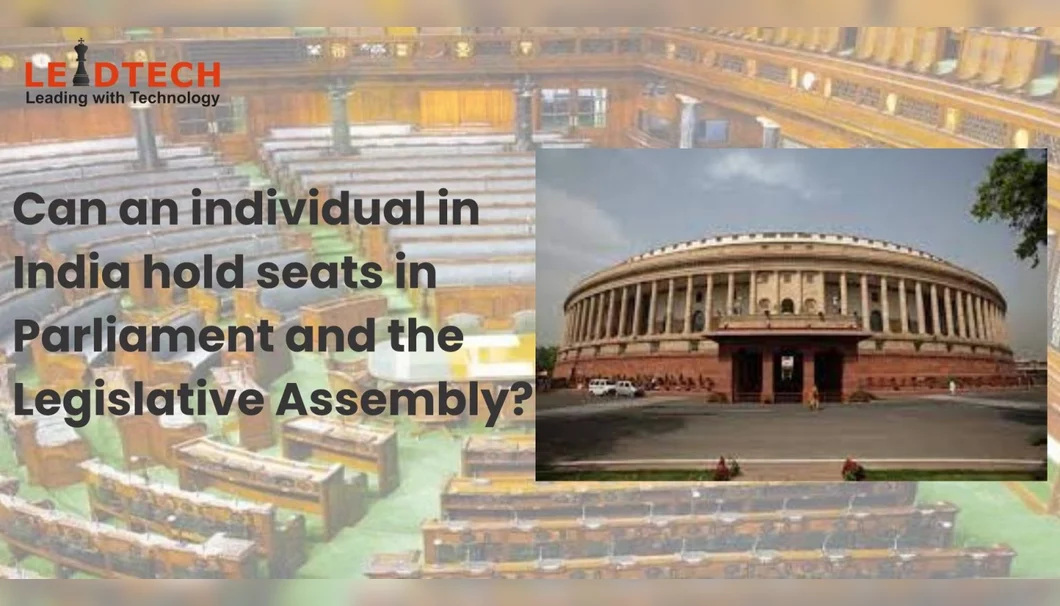
Can an Individual Hold Parliament and Assembly Seats in India?

A person may run for office in a general election, more than one by-election, or biennial elections from a maximum of two seats under Section 33 of the RPA, 1951.

Candidates were allowed to run in as many constituencies as possible prior to this law. According to Section 70 of the Act, if a candidate wins both seats, they are required to leave one within ten days, calling for a by-election. 

As per the Constitution, a person is not allowed to hold more than one seat in a House or serve as a member of both the House of Commons and a state legislature at the same time. 

Procedures and timelines for effect:

I. Lok Sabha and Rajya Sabha 

Article 101(1) of the Constitution, read with Section 68(1) of The Representation of the People Act, 1951 says:

If a person is elected simultaneously to both the Rajya Sabha and Lok Sabha, and if he has not yet taken his seat in either House, he can choose, within 10 days from the later of the dates on which he is chosen, which Houses of which he would like to be a member.

The member must intimate his choice in writing to the Secretary to the ECI within the 10-day window, failing which his seat in Rajya Sabha will fall vacant at the end of this period [Sec 68(2), RPA 1951].

The choice, once intimated, is final. [Sec. 68(3), RPA, 1951]

No such option is, however, available to a person who is already a member of one House and has contested the election for membership of the other House.

So, if a sitting Rajya Sabha member contests and wins a Lok Sabha election, his seat in the Upper House becomes automatically vacant on the date he is declared elected to Lok Sabha. The same applies to a Lok Sabha member who contests an election to Rajya Sabha. [Sec 69 read with Sec 67A, RPA 1951]

II. Elected on two Lok Sabha seats

There is no one in this category in the new Lok Sabha. Under Sec. 33(7) of RPA, 1951, an individual can contest from two parliamentary constituencies.

But, if elected from both, he has to resign one seat within 14 days of the declaration of the result, failing which both his seats shall fall vacant. [Sec. 70, RPA, 1951, read with Rule 91 of the Conduct of Elections Rules, 1961]

III. State Assembly and Lok Sabha

Article 101(2) of the Constitution, along with Rule 2 of the Prohibition of Simultaneous Membership Rules, 1950, made by the President under this Article, says:

After being elected to the Lok Sabha, state legislators are required to step down from their positions within 14 days, “from the date of publication in the Gazette of India or in the Official Gazette of the State, whichever is later.” If this doesn’t happen, their Lok Sabha seats will immediately become vacant.

Categories
Election 2022

Download Voter List 2022

Download Voter List 2022

Political parties and elections play a significant role in the development of a country. With the increase in awareness amongst the citizens, it has become important for the political parties to make well-suited strategies to win the elections.  

But, one challenge the political party can face here is the lack of information about the voters. Having no to minimal detail about the voter can be a constraint in building winning strategies. In this case, you can take the help of the voter list. 

As voter list has information about the potential voters, you can build your strategies around it. Having information related to the voters can help you stay ahead of the opposition. Continue reading about the importance of voter list and how we can help. 

Importance of Voter List

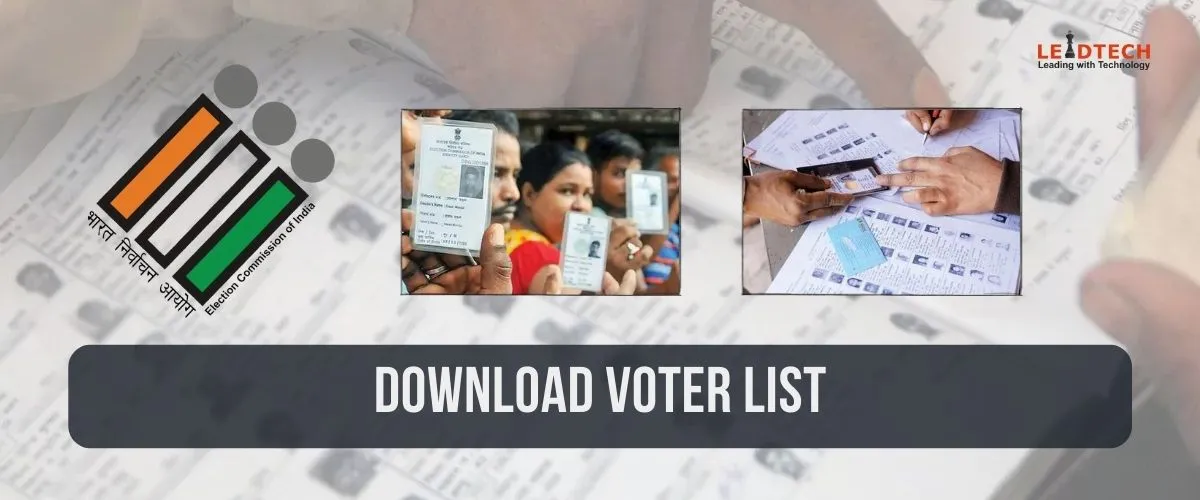
A voter list is the list of people eligible for voting in a constituency. The voter list is updated from time to time through proper research and analysis. Every constituency has its voter lists. It has information about the people who can cast their votes. Also, it is essential and forbids any illegal practice.

Apart from it, the voter list is an essential tool for the political parties in India. It contains all the information, interests, and gender of the voter. Through these details, you can build a winning election strategy. It will also help in the preparation of the manifesto.

How can LEADTECH Help?

download voter list 2022

LEADTECH is a political campaign company in India. We are a leading political consulting company. We can help you to analyze the political insights and make a winning strategy around them. Having been in the business for more than 12 years, we help our clients to achieve their goals and eventually win the elections.  

Our main mission is to provide tension-free services to our clients. Connect with us to download the voter list, for 2021 and 2022.

Purchase and Download Voter list in excel format for Various Indian States

S No.StateS No.State
1

Download voter list 2021

3

Download voter list 2022

2

Download voter list Delhi

4

Download voter list uttar pradesh

If you want to download voter list in excel format, then you must contact us at our contact number. We will provide you updated voter list of each and every constituency.