
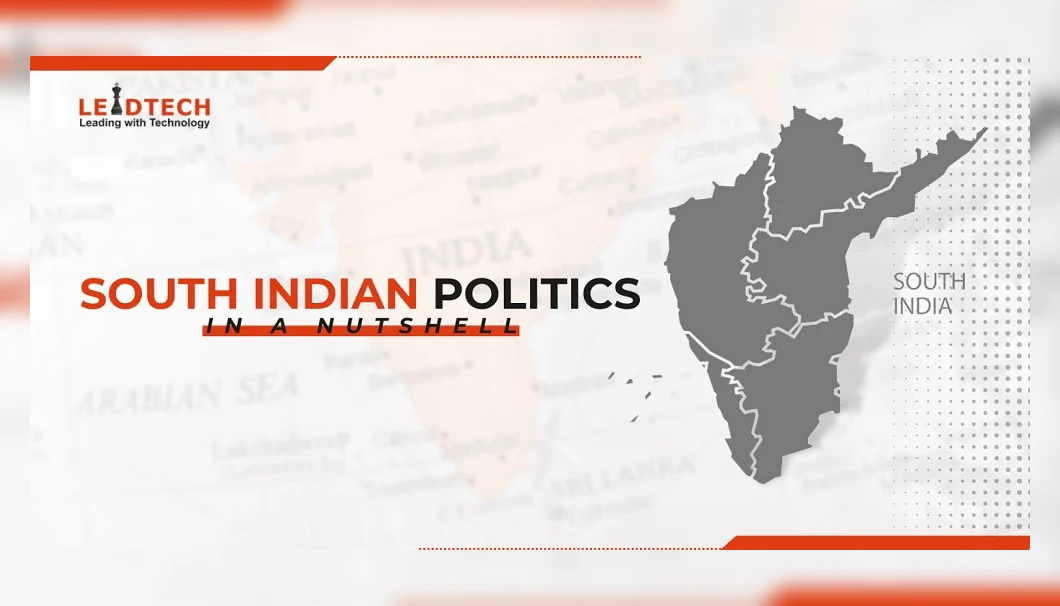
Politics in South India is particularly distinct. Most southern states have strong linguistic and cultural identities, which ensures the inevitable dominance of regional parties, and the subsequent growth limitation of national parties.
DEFYING THE NORM
Admittedly, during the early years of post-independence, Congress penetration was deep, but one of the first Indian states to defy the norm was a Southern state (Kerala, 1957, CPI government). Tamil Nadu went next, and elected a DMK government in 1967. Andhra Pradesh and Karnataka both came next in 1983, successively electing TDP (on 9 January) and Janata Party (on 10 January) respectively.
NARRATIVE BUILDING
Regional politics is not new in India. Parties always come into existence to satisfy a public need – and regional parties do exactly that. But many of these parties burn out when their narrative weakens or if their narrative becomes too exclusive. TDP was conceptualized by harnessing the Telugu identity, but the party ceased to make it their focal point gradually, and TRS filled that gap. Now TRS is on the same path.
STILL STRONG
But many parties continue to sustain themselves, even when external forces attempt to enter the contest. Kerala, which had a highly active, hyper-aware working-class community, naturally gravitated towards the mobilizing Communists as early as the 1950s. Even today, they manage to come back to power intermittently. Congress leader C Rajagopalachari’s insistence on Hindi gave birth to the imposition-resistant DMK, and virtually eliminated Congress from Tamil Nadu for many years to come. Even though Congress now features in TN politics, it is only a minority partner in a SPA coalition headed by DMK; and unsurprisingly, the party still hitting the language chord (BJP) sits as a minority partner in the Opposition. Andhra Pradesh and Telangana have now managed to virtually keep both INC and BJP out of power.
THE EXCEPTION
The only possible exception to this trend in South Indian politics is Karnataka. The state is not controlled by 3 parties, as is the popular belief. JD(S) is the main regional party, but it is only influential in a few areas, where loyal caste groups have kept it alive. National parties with singular narratives fill in the gap everywhere else. INC, which has not only lost its national narrative, but also several key leaders, still flourishes under a strong state leadership.
THE FUTURE
Democratic politics, to a large extent, is a game. It starts with a narrative, which evolves into a movement, and concludes with the election. If the narrative is strengthened, the need for a sponsored/organized movement is obviated – the public organizes it themselves. The elections then just act as a formality – a yardstick to measure the impact of the narrative.
Especially in a country as diverse as India, where dialects change every 20 kilometers, a common narrative is not only the best possible strategy, but also the need of the land. The public demands a unifying message – without which they would feel rudderless. Even if it polarizes them, narrows their minds, or causes them discomfort otherwise – it provides a sense of security; of belongingness.
South India politics may appear like a whole nother game. The states do not align themselves with national narrative, yet they make no attempts to secede. They want to stay a part of the family, but still hold onto their own identity. This shall continue for the foreseeable future – which is what the trends prove too.
HOW WE CAN HELP YOU
If you’re a political candidate or party, or even an influential leader with political ambitions, look no further. In today’s age, everyone needs professional expertise in building strong narratives, propagating them, and executing a mass movement. Leadtech has been in this profession since 2008, and is still going strong. Leadtech has handled over 1400 clients and led 95% to victory. With project coordinators and teams employed all over the country, Leadtech’s teams have an in-depth understanding of local politics and sentiments, and the resources to execute campaigns to help their clients emerge victorious. Contact the Director, Vivek Singh Bagri at 9650060882 for more information.