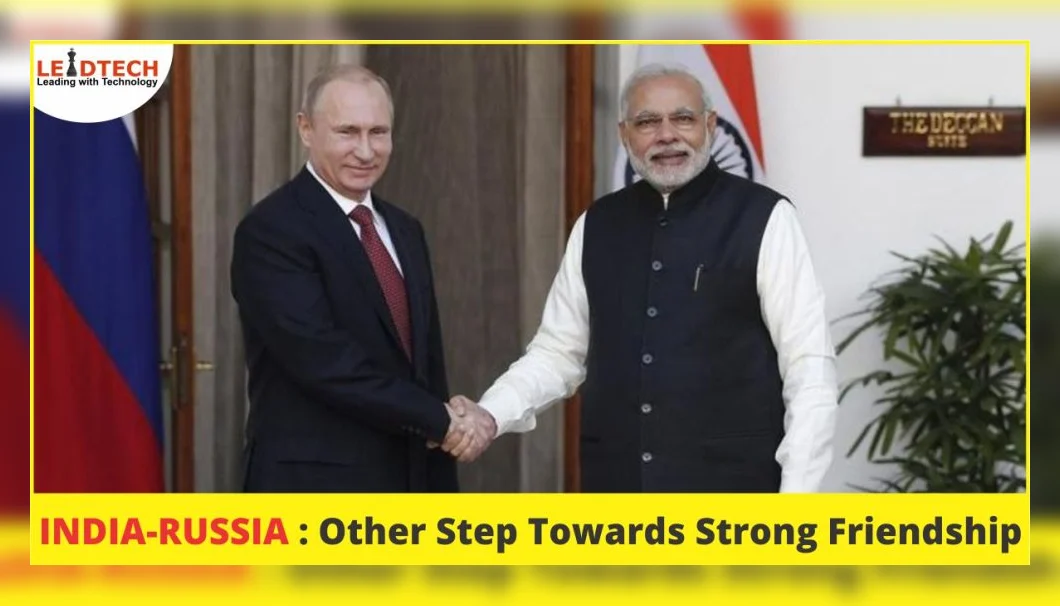
A virtual summit of Eastern Economic Forum (EEF) was held on 3rd September 2021. A virtual meeting was attended by the heads of the government of the participating countries. Both PM of India Mr. Narendra Modi and President of Russia Mr. Vladimir Putin interacted with each other. While addressing the session PM of India Mr. Narendra Modi stated that “India-Russia Friendship has stood the test of time by recalling the “robust” collaboration shared between the two countries during the COVID-19 pandemic and including the vaccination programme.
Key takeaways from the meeting
India’s PM addressed the Plenary Session of Eastern Economic Forum (EEF), and said energy is the another major pillar of strategist partnership between two countries.
India and Russia can together help bring stability to the global energy market.
Russia’s energy Ministry expects gas supplies via Nord Stream 2 to start in 2021.
Plenary Session:- A plenary session or plenum is a session of a conference which all members of all parties are to attend. Such a session may include a broad range of content, from keywords to panel discussion.
About Eastern Economic Forum (EEF):
The 6th Eastern Economic Forum held in Vladivostok in September. 2-4 in Hybrid (combined: online and in person) format.
Main topic of business is “New Opportunities for the East in a Changing World”.
It would be interesting to watch how the new business topic will positively impact both of the countries, and how much opportunities will it bring in the East. Since Russia has always positively supported India in terms of growth including energy growth, defense growth and manufacturing sector.
The ongoing Covid-19 Pandemic has posed unprecedented challenges in our lives. The effects of demonetization, mismanagement of covid-19 in many parts of India, Job crisis and the low number of sitting in the parliament where vital issues are being discussed and debated and above all the role of opposition parties in raising the voice of voiceless people are the major cause of concern. The recent developments in Indian Electoral Politics have changed the narratives and our perspectives too about the style of leadership, hereditary nature of Indian leadership, the role of coherent ideology, the manner in which decisions being made and implemented and political parties approach towards reaching the various social groups, etc. As many political experts say that despite having declined in electoral politics since 2014, one cannot imagine the Indian politics without the Congress party and it still plays a pivot role.
This article has focused on the current state of Indian politics and the speedy decline of the Congress party from National politics particularly after 2014 and the possible ways forward.
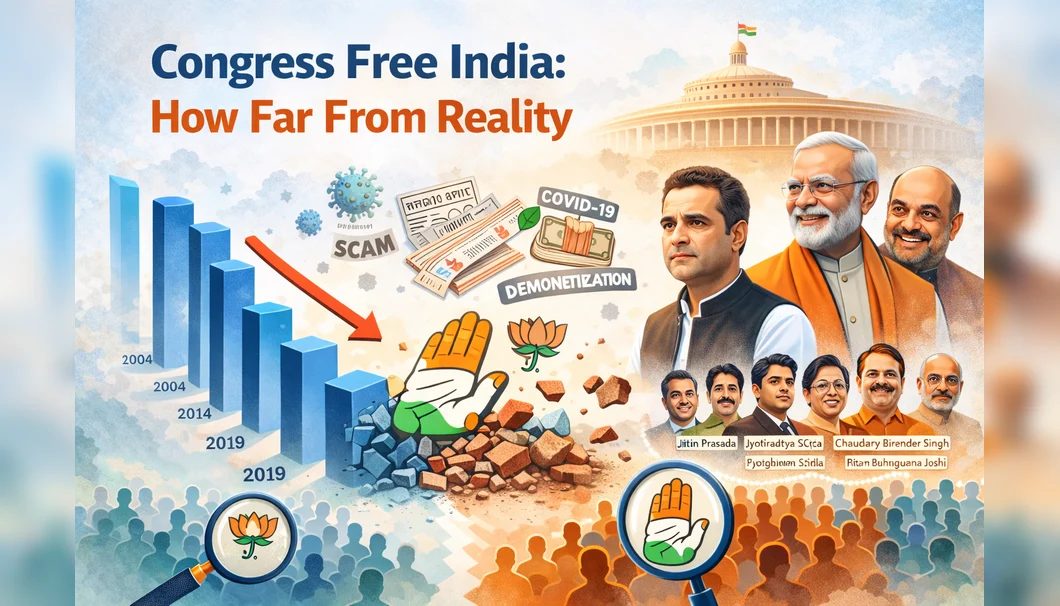
Glimpses of INC performance in the general election from 2004 to 2019
From 2004 to 2014 the congress party with help of other regional parties was able to form a govt. by defeating the National Democratic Alliance (NDA) led by the BJP.
However, there are many theories, as propagated by political experts, around the decline of the Congress party. Many political pundits have argued that it has created a space for political entrepreneurs that led to various corruption scams such as the earlier Bofors scam, 2G scam, Sahara Scam, and poor governance system while others believed that lack of charismatic leadership, connectivity with masses, and social engineering of caste groups, etc. Many political observers even including ex-congress leaders (now in BJP) have mentioned that their personal growth has stagnated and decision-making process has been hijacked by a few veteran leaders that led to suffocation. For instance, referring to Rahul Gandhi, “Our once and future king” tweeted by a senior leader of the Congress party on the death anniversary of Rajiv Gandhi. What does it show? Do we believe in democracy or chamchagiri? While on other hand pursuing president Pranab Mukherjee and giving a warm and emotional farewells to senior leader Gulan Nabi Azad was another political gesture of BJP.
Politicians Who Thought to Left the INC
Milind Deora who thought to left the INC as INC didn’t like his idea on Article 370. Since he supported the BJP’s strong decision on the suspension of Article 370 but congress party simply opposed his ideological stand.
Sachin Pilot was another politician who was quite in news for going against the INC. The simple reason going against the party in Rajasthan was all hard work and Party campaigning was done by him but CM candidature offered to Ashok Gahlot.
All is not well in the Congress Party
Here is the list of prominent leaders who were earlier in the congress party but now have left and joined BJP as if
Jitin Prasad
Jyotiraditya Scindia
Chaudhary Birender Singh
Rita Bahuguna Joshi
Tom Vedakkan and the list goes on.
Many political scientists believe that lack of consistency in policy decisions and policy actions, no coherent ideological commitment, growing Left-Congress synergy, and of course lack of personal growth of leaders, etc. are the possible reasons. For instance, Left-Congress Synergy has been unproductive as well as confusing for common party workers. In West Bengal they (Congress and Left together) fought election against Mamta Banerjee but what about in Kerala where Congress and Left parties were contested against each other.
Way forward
In the 2019 general election Rahul Gandhi was defeated by Smriti Irani in the Amethi Lok Sabha seat but manage to get elected from Wayanad (Kerala). In August 2020, G-23 i.e. 23 senior leaders of the Congress party have expressed their concerns to interim party Chief Sonia Gandhi. They have expressed their views on the poor performance of the Congress party in two consecutive general elections, bringing all structural reforms, self-introspection, and strategizing for upcoming elections. Even the post of Congress party president is still waiting for a full-time president. It was a clear political gesture to the congress party to rethink or purnavichar, restructure its party composition and bring fresh and young people to the party. But as being acknowledged by BJP-RSS senior leaders that still the congress party is the biggest challenger to the BJP party despite having a continuous decline. It is because it has managed to secure approx. 20% of total votes in two general elections i.e. 2014 and 2019 while the rest of the parties (excluding BJP) were not able to cross double-digit. It means at the bottom side it has maintained the status quo. Any increase in this percentage will surely affect the BJP vote share and would have led to a coalition government as well. Gandhi’s Family is still key to the Congress party that’s why Modi-Shah led BJP party keeps on attacking Gandhi Family. The Congress party needs to focus on
To understand the changing nature of young voters, their aspirations and demography dividend and do all needful accordingly
Innovative political Strategies and to communicate the masses at a large scale by judicious utilization of ICT platform.
To provide some paces to local/regional parties and help them to form stable government where the Congress party is not in majority. Do not become power-hungry but adaptive according to the prevailing political scenario.
Of course restructure its political organization or even vacating various seats as well otherwise many more leaders are waiting to join the BJP.
The term Monsoon derives from the Arabic word which means a seasonal reversal in the direction of winds. It is well-known fact that agriculture is the backbone of the Indian economy but due to its high dependence, is considered a gamble against the Monsoon. Monsoon plays a key role particularly in the season of kharif but it has deep-rooted consequences on the economy and our lives throughout the year. As economists say “the impacts of Demonetization and GST are still visible on our economy but covid-19 added fuel in the fire. In 2020-21 we have witnessed worst ever contraction in our economy while agriculture registered 3.6% positive growth”. In this article, we have tried to establish the relation between Monsoon and Indian economy and the impact of covid-19.
How monsoon can affect the Indian Economy
Monsoon is likely to be normal this year in India, marking a hat trick as per Skynet. It has also said that the South-West monsoon in 2021 is likely to be normal at 103% of the LPA which starts from June, brings India 70% of its annual rainfall.
India agriculture and food supply:
As Indian agriculture is heavily dependent on monsoon that’s why for farmers, water is more valuable than gold. Approximately 65% to 70% of people are dependent on agriculture and allied activities either directly or indirectly and around derived their livelihoods. Agriculture to GDP contribution stands for 19% (subject to vary based on revised estimation). There is a direct relationship between food security and monsoon. A decrease in monsoon results in low production of food grains, increase price rise, and low demand that affects the whole food supply chain.
Impacts on GDP:
As per the latest figure agriculture in India contributes around 19.9% to GDP. Any changes in the monsoon pattern would affect the volume of agriculture production, decrease in the availability of raw materials for the industries/sectors dependent on agriculture that results in an overall reduction in economic activities.
Balance of trade:
Balance of trade is also depend on changes in monsoon. If the monsoon is favorable then there would be an increased in the volume of production. While in case of failure of monsoon then there would be a negative balance of trade which resulted into the fall of revenue and increased in government expenditure.
Rural Economy:
India predominantly being an agriculture driven economy and roughly 65% to 70% of the population depends on agriculture and are driving their livelihoods through agricultural and allied activities. Rural economy has played a critical role in the lives of masses (as the majority of people reside in the rural area). It helps in providing farms related employment, eradicating poverty, and channelizing cash flow but as stated above that monsoon like a gamble. Failure of monsoon would affect the whole cycle of the rural economy, their livelihoods, and increase in government expenditure.
Why monsoon is important to recover the Indian Economy from Pandemic
A good monsoon plays a very important role in the Indian Economy due to the following reasons. 60%-70% of our population is dependent on agriculture. 56% of India’s net sown area (land of which cultivation is done at least once a year) is dependent upon monsoon for watering the crops. 56% area produces around 44% of India’s agricultural output. A good monsoon results in a good harvest and bumper production. For the past 2 years, 2019-20 and 2020-21, food grains production in India has touched a record high.
Key Highlights: Survey facts from Ministry
The finance minister, Ms. Nirmala Sitharaman tabled the economy survey 2020-21 on January29, 2021 and stated that in 2020-21, the growth rate of agriculture is estimated to be 3.4%, while the contribution of the sector to GVA (gross value added) declined from 18.3% to 17.8% between 2014-15 and 2019-20. It is estimated to increase to 19.9% in 2020-21. This is because the agricultural sector faced not much disturbance on an account of the COVID-19 pandemic as compared to the non-agricultural sector.
How Pandemic has effect the Indian Economy over a year (in context of monsoon)
Agriculture Marketing:
Bumper production increases the food security of the country, this leads to an increase in stocks which are then used to provide free ration to the poor. India currently has 3.5 times more stocks than the buffer norms fixed in January 2015. These stocks were used last year to provide free ration to 80 crore beneficiaries for 8 months to help them tide over the economic devastation caused by the pandemic and the lockdowns. This policy is being implemented this year in the second wave as well. A normal south-west monsoon along with comfortable buffer stocks should help to keep cereal price pressures in check. The weightage of food items in the Consumer Price Index which is used to measure inflation is 50%.
Market Rise:
A normal south-west monsoon along with comfortable buffer stocks should help to keep cereal price pressures in check. The weightage of food items in the Consumer Price Index which is used to measure inflation is 50%. Hence a normal monsoon would ensure that inflation remains in the band of 4%-6% as targeted by the Reserve Bank of India. Low inflation will help the Reserve Bank of India to continue with its stance of keeping interest rates low. Generally, central banks resort to an increase in interest rates to tackle high inflation. A low rate scenario is required at a time when the Indian economy is battling the economic fallout of the pandemic. This will help fuel growth as it makes credit affordable. High rates will be a dampener at this juncture.
Effecting the rural sector:
India is a predominantly rural economy with 65% of the population residing in villages. The rural economy contributes 45%-50% to our gross domestic product. India is a predominantly consumption-dependent economy unlike China which is export-oriented. A higher rural income after a good harvest will boost demand for consumer goods, two-wheelers, and tractors. Consumption accounts for 55% of GDP, however, growth has been impacted in the last year due to the pandemic. A normal monsoon will provide a boost to rural incomes, rural demand, overall consumption, and hence to the GDP as well.
Inflation:
The Consumer Price Index (CPI) based inflation was 6.6% in 2020-21 (April-December). The inflation mainly due to food inflation which increased from 6.7% in 2019-20 to 9.1% in 2020-21 (April-December).
As stated above that agriculture is a gamble against the monsoon and it has social, economic, and political repercussions. The impacts of the Monsoon are not only confined to crops but also cut across the industries as well. Therefore we need to have a sound agricultural policy along with basic infrastructural developments so that we could increase our resilience power, minimize the risk against unprecedented challenges posed by Covid-19, and build our capacity and capability as well.