
Categories
Election PR Management

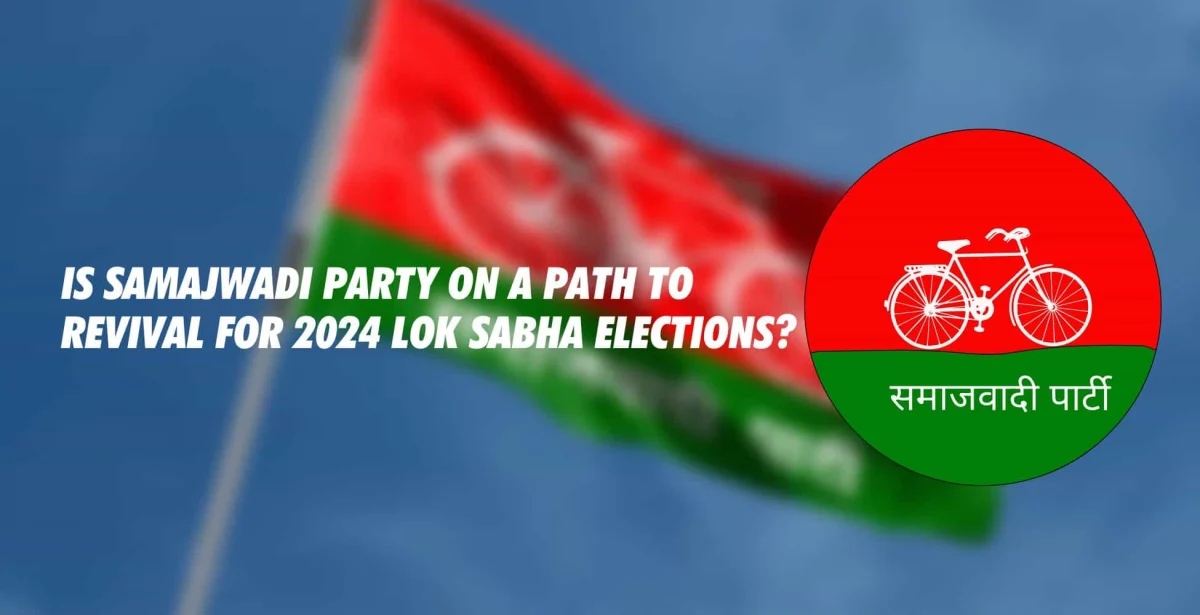
Is Samajwadi Party on a Path to Revival for 2024 Lok Sabha Elections?

Samajwadi Party

After Samajwadi Party’s improved performance in 2022 UP Assembly Elections (combined with BSP’s massive decline), many were speculating whether SP was set to regain its ground in Uttar Pradesh.

The next major elections in UP will take place 18 months from now. The 2024 Lok Sabha Elections will be a determinant about the state of SP in the state. In the past election of 2019, in which BJP swept the state, taking 62 out of the 80 seats, SP was in alliance with BSP and RLD.

But presently, the Bahujan Samaj Party has almost diminished entirely. The party which once ruled the whole of Uttar Pradesh independently, only managed to win 3 seats in the 2022 Assembly elections. Hence, it is unlikely that SP would want to form an alliance with them, or even that they can win in Lok Sabha in their individual capacity. There was a shift in the preferences of BSP’s loyal voters, and hence the party has weakened at the ground level. The 10 seats they won in 2019 are at risk of being won by either BJP or SP.

SP, in the alliance of 2019, did not benefit much. The alliance partner BSP won 10 of the 38 in which they contested, while SP won only 5 of their 37. In fact, they even lost 3 of them by the end of 2022. Rampur’s Azam Khan had to resign following his conviction, Azamgarh’s Akhilesh Yadav resigned when he won in the UP Assembly, and Mainpuri’s Mulayam Singh Yadav passed away recently. Both the former 2 seats were won back by the BJP in bypolls, and the third one is currently in the process of electing a new MP. Therefore, presently, SP is barely
represented in the Lok Sabha.

BJP continues to remain a strong force in UP. It is very unlikely that their seat share will reduce majorly, even in 2024. They might see a slight change, which could be either positive or negative, depending upon the opposition forces. But the fact of the matter is, their vote share has consistently stayed high, and hence seats are not a major worry for the ruling party.

Players like AD(S) are expected to hold their seats. In the past 2 cycles, the Anupriya Patel-led party has won the two western-most seats in UP. Parties like RLD have contested a few seats in both 2014 and 2019, but have remained unsuccessful so far. JDL was formed only recently, and this will be their second general election, but even then, they are only likely to contest one seat (Kaushambi). Overall, none of their leaders are influential enough nationally to create a wave and influence the results.

Congress could have potentially been considered a serious contender in UP, especially following their recent party restructuring and Bharat Jodo Yatra. But their yatra route in Uttar Pradesh is considerably shorter in proportion to the seats the state carries. Hence, their performance in 2024 is still doubtful.

This only leaves Samajwadi Party as the main opposition to BJP in the 2024 General Elections. Without an alliance, back in 2004, SP peaked by winning 35 of the 80 seats. Their performance was a result of Mulayam Singh Yadav’s leadership. But with him out of the picture, the pressure comes on his son, Akhilesh’s shoulders. Since leaving office in 2017, his party went through a severe decline, until 2022, when they saw some improvement in the Assembly elections. If his wife Dimple Yadav wins in the upcoming Mainpuri by-elections, SP might be in a position to win more in 2024. In any case, regardless of the aforementioned results, SP is set to win back most of the BSP seats. But unless Akhilesh pulls up his socks and actively opposes the BJP, before and during elections, their party is in the same danger as BSP.
    Get in Touch


    By clicking Submit, I hereby authorize Leadtech and its affiliates to call, email, send a text through the Short messaging Service (SMS) and/or Whatsapp. The consent herein shall override any registration for DNC/NDNC.

    Categories
    Political research

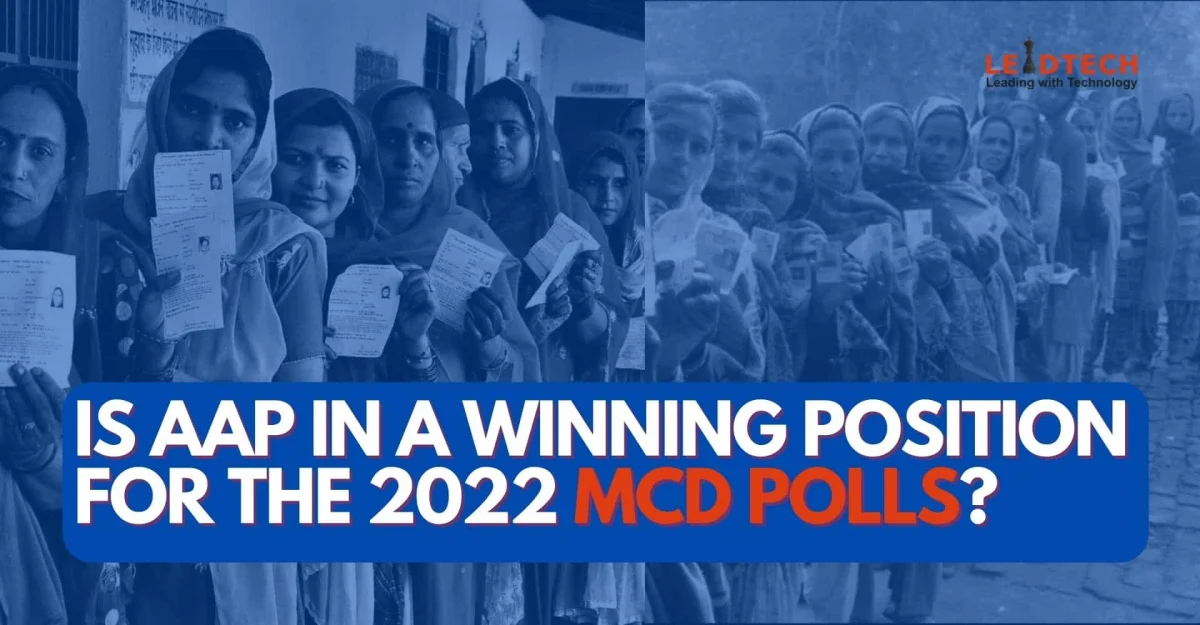
    Is AAP in a Winning Position for the 2022 MCD polls?

    AAP IN A WINNING POSITION

    BJP, which has not had a single Chief Minister of Delhi since the early 90s, has had several mayors administering Delhi. For the past 15 years, they have held power at the Municipal level and consistently grown in seat share. Their vote share continued to remain stagnant at about 36%, yet in 2017, they had won 67% of the seats.

    REASONS FOR WINNING M.C.D.

    In 2007, when their (presently) main opposition AAP did not exist, BJP won marginally against INC. Congress’s share was diluted by other opposition parties, and BJP, a strong national opposition at the time, took advantage of this. However, in 2008, Sheila Dikshit managed to win another term despite losing control of the MCD.

    In 2012, the downfall of INC in Delhi continued, fueled especially by the 2011 anti-corruption protests and the 2010 Commonwealth scam. BJP won a pure majority (138 seats out of 272) – but it must be noted that AAP had not contested this time.

    To understand the results of the 2017 election, we must understand AAP’s growth trajectory. After the infamous 2013 AK49-term, Arvind Kejriwal won a thumping majority in the Delhi state assembly. INC was completely booted out while BJP had only 3 seats, giving birth to the “Entire Opposition in One Auto Rickshaw” joke. The reason AAP did so well in 2015 Delhi Assembly elections is because of Kejriwal’s appeasement manifesto, which only targeted the lower-middleclass of Delhi. In both 2017 MCD elections and 2019 Parliamentary elections, AAP suffered badly. BJP in fact gained 43 seats when AAP contested for the first time, and swept all 7 Lok Sabha seats. Despite these failures, AAP retained power in the Delhi Assembly in 2020.

    The Aam Aadmi Party did eat away at Congress’s share, but they could not position themselves in a way that the majority considered them worthy of getting the mandate – something that BJP was able to do. One may understand why, at the national level, Delhiites chose BJP over AAP, but why at the administrative level too?

    THE PRESENT CAMPAIGNS

    It is safe to say that Congress has lost its ground in Delhi. There are only two main parties in Delhi, and they are both actively campaigning in Delhi. Even before the December 4 polling date was set by the courts, MCD elections had been a major part of the political discourse. The matter of trifurcation was even taken up in the Indian Parliament.

    AAP, which desperately needs control of the MCD to fully deliver their promises to the public of Delhi, has been running a “Helpless” campaign since 2020. Their claims, although true, are strategically disseminated to the aggrieved public whenever they hold AAP accountable for shortcomings in their civic life. Be it TV debates or through their official and non-official social media handles, AAP has maintained that they have always been up to the mark in their work, but a lot of civic matters do not come under their jurisdiction, and since they don’t have control of the MCD, they can’t be held accountable. They want to help the people of Delhi, they claim, but they are “helpless” as long as BJP stays in power.

    BJP’s campaign in response has been tepid at best, mainly because it is a reactionary campaign. When AAP puts the blame on BJP by quantifying the lack of delivery of promises, BJP does the same. There are a lot of sharp words exchanged but BJP has not provided a reason why they should stay in power.

    WHO WILL WIN THIS TIME?

    The blame game is a very common element in bipolar elections, but technically, the odds are more in favor of AAP this time.

    From a voter’s perspective, if BJP is voted back into power, Delhi’s civic amenities will most likely continue to suffer. Kejriwal and the new mayor will continue to have scuffles and each party will try to bring the other down. Kejriwal will double down on acting helpless, while BJP will continue to attack him. In this case, the mayor might be positioned as the new CM face, and could replace Kejriwal in 2025, leading to the original outcome of the same party holding both the state assembly and municipality.

    On the other hand, if AAP wins, they will gleefully stop blaming the BJP, but will have immense pressure on their head to prove that they are capable of undoing BJP’s “bad work” and doing the “good work” they promised. If they fail to do so, there is a possibility that BJP might take over the assembly from them in 2025.

    Hence, from a rational viewpoint, AAP is more likely to win. But elections involve real voters, most of whom are not original thinkers. What matters is what they are made to believe, not what they actually believe. There are still other factors to consider.

    OTHER FACTORS TO CONSIDER

    BJP’s support base, as seen in the past 15 years, is consistent – their base supporters are loyal. Be it Lok Sabha or Vidhan Sabha or MCD, they have the support of at least 36% voters. AAP does not have loyal voters – it has situationally-loyal voters. Considering this factor, BJP is more likely to win. But AAP has not contested MCD elections often enough (just once) for anyone to determine their voter loyalty.

    Therefore, it is possible for the election results to swing either way, depending upon the steps taken by either party.

    The first step in winning any election is understanding the voter sentiment, which is done by conducting surveys either internally or by hiring a reliable external agency, like LEADTECH. However, for this election, which is less than a month away, many might want to skip this step and jump straight to campaigning – especially important in weaker wards. This is another service in which LEADTECH holds a lot of expertise due to years of experience.

    While both parties are aggressively strategizing and aiming to win the most seats, some wards are weak and need special attention. Nominees from these wards should hire external help in addition to their party’s assistance, if they want to guarantee a win. For that, LEADTECH would be able to provide several services, including door to door campaign, social media, war room, public relations, and many more.

    GET IN TOUCH

      Get in Touch


      By clicking Submit, I hereby authorize Leadtech and its affiliates to call, email, send a text through the Short messaging Service (SMS) and/or Whatsapp. The consent herein shall override any registration for DNC/NDNC.

      Categories
      Election PR Management

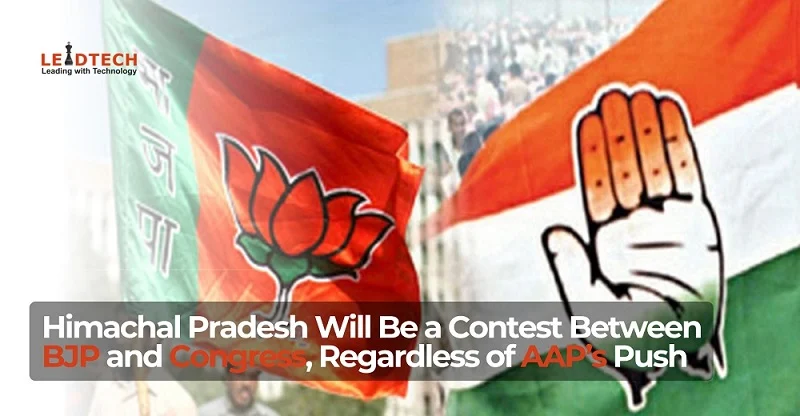
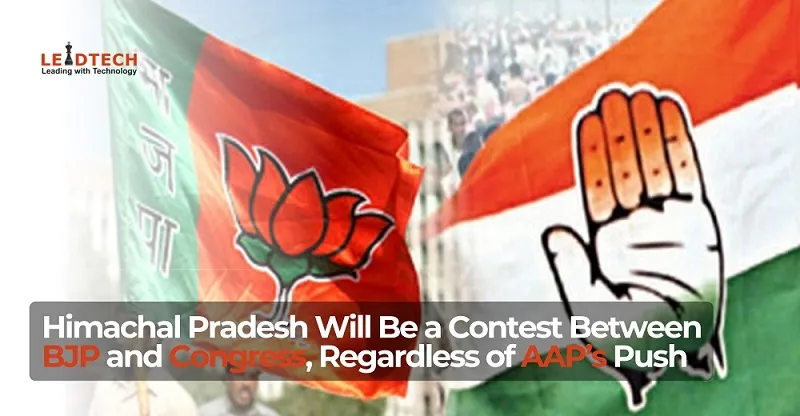
      Himachal Elections: BJP vs Congress, Regardless of AAP’s Push

      HIMACHAL PRADESH ELECTION

      The Aam Aadmi Party i.e AAP with Arvind Kejriwal has professed their national ambitions following their thumping win in the certain Punjab assembly elections. Himachal Pradesh assembly election 2022 for AAP as it is preparing to give a setback to the ruling party i.e Bharatiya Janta Party (BJP).

      Aam Adami Party is a state-familiar party in Goa after Punjab and Delhi. Arvind Kejriwal said that if we get recognized in one more state for example in the Himachal Pradesh assembly election 2022 then we will be declared officially as a national party.

      As we know Himachal Pradesh assembly election 2022 is arriving, and the Himachal Pradesh election campaigning of the ruling Bharatiya Janta Party is at its peak. In the past decades, elections have been witnessed between Congress and BJP. This time, the Aam Aadmi Party (AAP) is in a tough election fight, but mainly the contest is being seen between the earlier ruling parties i.e. the BJP and the Congress in this Himachal Pradesh assembly election 2022.

      If AAP wins in the Himachal Pradesh assembly election 2022, then Arvind Kejriwal’s Aam Adami Party has promised free 300 units of electricity to every household consumer. On the other hand, this move of the Aam Adami Party has bothered Bharatiya Janta Party and Congress, so both parties have made similar announcements in a bid to persuade the voters. Whereas, Kejriwal’s party is not bothered by the same proclamation made by Bharatiya Janta Party and Congress because AAP is sure to win the Himachal Pradesh election polls. 

      What is the Congress Strategy for Himachal Pradesh Assembly Election 2022?

      Just like the Aam Adami Party, even Congress has announced to offer 00 units of free electricity to every household consumer and for the age of 18 to 60 years old women Rs.1500 per month.

      Congress, the striking old party has appointed Pratibha Singh, as the state unit president. It is mainly banking on the anti-incumbency factor and has promised to bring back the OPS i.e. Old Pension Scheme.

      What is the Bharatiya Janta Party’s Strategy for Himachal Pradesh Assembly Election 2022?

      Based on the performance the Bharatiya Janta Party (BJP) is confident of coming back. This ruling party is not concerned about the Congress and Aam Adami Party. In all Lok Sabha segments in Himachal Pradesh, it has helped conventions of booth-level officer-bearers.

      The ruling Bharatiya Janta Party, which is converging on ‘Mission repeat’ to hold power in the State, is leaving no stone unturned to ensure (BJP) the saffron party’s victory in the election to the 68-member State Assembly.

      In the past few months, its protruding leaders including Prime Minister Narendra Modi, Home Minister Amit Shah, and party’s national president J.P. Nadda, who hails from Himachal Pradesh, and Defence Minister Rajnath Singh have addressed several rallies among themselves to gather people’s support. Even, Mr. Narendra Modi has addressed two rallies and is slated to address another one in Chamba. After the rally in Chamba, the model code of conduct for the Himachal Pradesh assembly election 2022 is likely to be announced soon.

      After its vigorous win in the Punjab Assembly elections, the AAP stepped up the speed of its electioneering with party supremo and Delhi Chief Minister Mr. Arvind Kejriwal and Punjab Chief Minister Mr. Bhagwant Mann holding several road shows and public rallies. However, off-late, AAP’s conspicuous leaders have been involving their energy more in poll-bound Gujarat and the local leadership is canvassing for the party in the State.

      As the Congress is being seen as the key challenger for the saffron party (BJP), a section of Congress party’s members feel that to counter the violent campaign of the Bharatiya Janta Party party, the party’s top leadership should be more energetically participating in the electioneering.

      In the past few months numerous prominent Congress leaders, including MLAs and working presidents have left the party, quoting confusion over party processes in the State. “As the party continues to suffer from factionalism, it’s natural that many party workers would feel dispirited.

      Naresh Chauhan, the senior Congress leader dismissed the claim that Congress was having a low-key campaign. “Our leader Priyanka Gandhi will steer the Himachal Pradesh election campaign in mid of October 2022. Also, once the election for the party’s national president position is decided, more leaders would visit the State for campaigning.

      The Bharatiya Janta party is campaigning aggressively because they are conscious of the fact that they are trailing in the upcoming election. By spending extensively on the Himachal Pradesh election campaign, the BJP is attempting to woo voters now as during the past four and a half years they have done nothing for the State and its people.

      If you are searching for best political consulting company in India then feel free to contact Leadtech. We, at Leadtech, gather the business’s valuable and accurate information and then examine it to generate political visions. For this determination, we employ advanced and cutting-edge tools. But nowadays, we are using the proficiency of our staff and technology similar to help elected representatives manage their constituencies in a planned way.

      We are best known for delivering hassle-free services to our clients. We are proud of our foremost values of “loyalty and integrity” towards our clients. To know in brief, feel free to contact us!

      GET IN TOUCH

        Get in Touch


        By clicking Submit, I hereby authorize Leadtech and its affiliates to call, email, send a text through the Short messaging Service (SMS) and/or Whatsapp. The consent herein shall override any registration for DNC/NDNC.

        Categories
        Election PR Management

        Why Start Election Preparations at Least 18 Months Early

        Why You Should Begin Preparations At Least 18 Months Prior to Elections

        Indian elections have become highly competitive in the past decade or so. With data-driven technology seeping deep into the electoral process, simple election techniques have become redundant and highly ineffective. Political aspirants have to work harder than before to shine brighter than their competitors, and ensure they have a profound impact on the constituents who they hope will support them in the polls.

        Most Indian constituencies need a lot of time and attention – either they are naturally heavily populated, or they are sparsely populated but spread in a way that constituents are harder to reach. In either case, a lot of energy needs to be devoted to reach out to each and every voter. Door to door campaigns are the cornerstone of all elections, despite moving into a more digital world, since the technology only complements the traditional process.

        The way to win an election is to map voters in all divisions of a constituency – be it for local corporations, the Assembly, or the Parliament. The aspirant needs to be aware of his/her strong areas and weak areas. This helps guide both manifestos and campaign action – both of which are crucial in flipping weak areas to strong, and also improving the situation in the constituency (and eventually the country).

        This data is not static – it is constantly evolving. Government agencies obviously do not provide such information, and general market researchers and news agencies may have biased data based on their sponsorships. A political aspirant needs to hire an agency for themselves to collect such data on a regular and real-time basis, so they are constantly updated on developments in the constituency.

        Many agencies can provide this service, but one of India’s foremost agencies working largely for individual clients is Leadtech Management Consulting Pvt Ltd. In the past 17 years, they have worked for over 1400 clients with over 95% success rate.

        However, simply mapping voters is not enough. Mapping is only the first step in this lengthy process – and it only reveals the real-time sentiment of the constituency. Constituents need to be influenced, motivated, and persuaded with a strategic vision and promises of a better tomorrow, under better governance. Communication (and narrative building in specific) is also guided by  data. This is followed by mass campaigns, which need to be designed according to the data.

        Political aspirants need to remember that they are not alone in this race. Their competitors are most probably working along the same lines, because as previously mentioned, data-driven elections have become the norm now. All parties and candidates have found that there is no way to win elections (or even attempt to win) except hiring external agencies for assistance and consultation.

        Choosing the right agency, at least 18 months prior to elections, is beneficial for twin reasons. Firstly, you get a headstart over your competitors. Even if they are better liked in your constituency, you will be able to reach more voters much before your competitor can, and thereby swing voters in your favor. This is only possible if enough time is given to the agency to function properly – not if you hire someone at the eleventh hour.

        Secondly, the right consultant with several years of experience can help you design a strong, solid winning campaign. Data is confidential and exclusively for the client, and plans are unique for each client. Hiring them 18 months prior helps you execute more of the strategy as per the plan, or else elements can be missed due to lack of time.

        Contact Vivek Singh Bagri (Director, Leadtech) at 9650060882 if you are a political aspirant and are looking for consultation for upcoming elections.

        Categories
        Election PR Management

        South Indian Politics – In A Nutshell

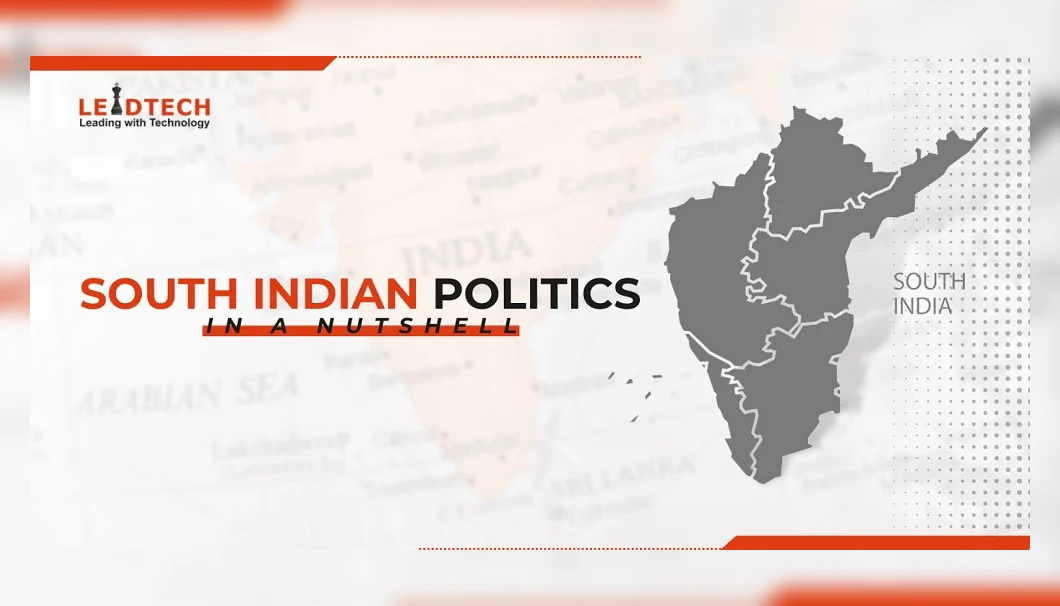
        Politics in South India is particularly distinct. Most southern states have strong linguistic and cultural identities, which ensures the inevitable dominance of regional parties, and the subsequent growth limitation of national parties.

        DEFYING THE NORM

        Admittedly, during the early years of post-independence, Congress penetration was deep, but one of the first Indian states to defy the norm was a Southern state (Kerala, 1957, CPI government). Tamil Nadu went next, and elected a DMK government in 1967. Andhra Pradesh and Karnataka both came next in 1983, successively electing TDP (on 9 January) and Janata Party (on 10 January) respectively.

        NARRATIVE BUILDING

        Regional politics is not new in India. Parties always come into existence to satisfy a public need – and regional parties do exactly that. But many of these parties burn out when their narrative weakens or if their narrative becomes too exclusive. TDP was conceptualized by harnessing the Telugu identity, but the party ceased to make it their focal point gradually, and TRS filled that gap. Now TRS is on the same path.

        STILL STRONG

        But many parties continue to sustain themselves, even when external forces attempt to enter the contest. Kerala, which had a highly active, hyper-aware working-class community, naturally gravitated towards the mobilizing Communists as early as the 1950s. Even today, they manage to come back to power intermittently. Congress leader C Rajagopalachari’s insistence on Hindi gave birth to the imposition-resistant DMK, and virtually eliminated Congress from Tamil Nadu for many years to come. Even though Congress now features in TN politics, it is only a minority partner in a SPA coalition headed by DMK; and unsurprisingly, the party still hitting the language chord (BJP) sits as a minority partner in the Opposition. Andhra Pradesh and Telangana have now managed to virtually keep both INC and BJP out of power.

        THE EXCEPTION

        The only possible exception to this trend in South Indian politics is Karnataka. The state is not controlled by 3 parties, as is the popular belief. JD(S) is the main regional party, but it is only influential in a few areas, where loyal caste groups have kept it alive. National parties with singular narratives fill in the gap everywhere else. INC, which has not only lost its national narrative, but also several key leaders, still flourishes under a strong state leadership.

        THE FUTURE

        Democratic politics, to a large extent, is a game. It starts with a narrative, which evolves into a movement, and concludes with the election. If the narrative is strengthened, the need for a sponsored/organized movement is obviated – the public organizes it themselves. The elections then just act as a formality – a yardstick to measure the impact of the narrative.

        Especially in a country as diverse as India, where dialects change every 20 kilometers, a common narrative is not only the best possible strategy, but also the need of the land. The public demands a unifying message – without which they would feel rudderless. Even if it polarizes them, narrows their minds, or causes them discomfort otherwise – it provides a sense of security; of belongingness.

        South India politics may appear like a whole nother game. The states do not align themselves with national narrative, yet they make no attempts to secede. They want to stay a part of the family, but still hold onto their own identity. This shall continue for the foreseeable future – which is what the trends prove too.

        HOW WE CAN HELP YOU

        If you’re a political candidate or party, or even an influential leader with political ambitions, look no further. In today’s age, everyone needs professional expertise in building strong narratives, propagating them, and executing a mass movement. Leadtech has been in this profession since 2008, and is still going strong. Leadtech has handled over 1400 clients and led 95% to victory. With project coordinators and teams employed all over the country, Leadtech’s teams have an in-depth understanding of local politics and sentiments, and the resources to execute campaigns to help their clients emerge victorious. Contact the Director, Vivek Singh Bagri at 9650060882 for more information.

        Categories
        Software Services

        Leadtech Software Services Clients

        Leadtech Software Services Clients

        Leadtech has an esteemed list of clients who have availed software services from the company in last 16+ years.

        1. Constituency Management Software

          1. There are nearly 1500+ clients in the political domain who are using Constituency Management Software.
          2. All the details of the voters, developmental work, Voter reach out, Household Info, Mobile numbers of the voters, caste demographics and voting trends can be managed effectively for making the analysis.
        2. Voter Information Management System

          There are nearly 2000+ clients using Voter Information Management System to manage and analyze voter information using this app.

          Constituency Management Software

          There are currently two types of VIMS apps:

          1. VIMS Data Collection App
          2. VIMS Data Management App


        Web Solutions

        Our IT Solutions are web-based online applications which can be accessed anytime, anywhere. We develop both static and dynamic websites and applications. Apart political software service in India, Leadtech has also developed its own online portal (www.infoelections.com) to track political developments all over the world.

          Get in Touch


          By clicking Submit, I hereby authorize Leadtech and its affiliates to call, email, send a text through the Short messaging Service (SMS) and/or Whatsapp. The consent herein shall override any registration for DNC/NDNC.

          Categories
          Election 2022

          21 Years of TRS – Will It Continue to Grow, Or Begin to Fail?

          TRS

          In Telangana, TRS is undoubtedly the dominant party. It was the first party formed with the single-point agenda of bifurcating Andhra Pradesh and creating Telangana. The party cited lack of development, disproportionate allocation of resources and employment, and differences in culture. TRS’s spearheading of the final Telangana Movement was ultimately successful in 2014, which elevated them to a much higher, distinct level, separate from other parties who also campaigned for separate statehood – TRS obtained a paternal image in the state.

          In the first assembly elections, they won 63 out of 119 seats. Over the next 4 years, they poached several MLAs from different parties. TDP was virtually extinguished by this exercise, and independent candidates also were swept out. In the 2018 elections, they won 88 seats, but by 2022, they have already poached another 15 MLAs to bring them to a grand total of 103. They are a super-majority government, with strongholds in every region of Telangana. MLAs from other parties felt compelled to join the party so their assemblies also witnessed fast development, as was promised by the TRS government. So far, BJP and AIMIM were the only 2 parties from which elected MLAs have never defected to TRS.

          TRS, in its 8 years of governance, has focused on appeasing varied voter bases by means of welfare schemes. This has led to 2 things – rapid development in many sectors – something which could not be attained in united Andhra Pradesh, and large voter groups who pledge loyalty to TRS. However, TRS has been inefficient in the delivery of many schemes – Double Bedroom Housing, for instance. The government also takes controversial decisions like GO 317 which alienates significant groups. TRS has not tapped into some key areas – employment is the biggest one of them.

          TRS has several weak areas besides their inefficiencies, including

          1. The feudal, nepotistic, corrupt conduct of KCR (especially evident in the cabinet – 62% is Upper Caste, only 11% women)
          2. The promotion of caste-based occupations – eg distribution of sheep & goats to Golla Kuruma communities
          3. The unjustified public spending (eg Rythu Bandhu which only benefits landowners, construction of new secretariat, etc)

          While TDP may have diminished in the state completely, and AIMIM is unlikely to expand its reach beyond Hyderabad, TRS faces competition from 2 parties mainly – INC and BJP. INC is stronger in Southern Telangana (this regional bastion has been consistent for a long time) and BJP is stronger in North (evidenced by recent wins in Lok Sabha) and urban areas of GHMC (evidenced by recent wins in the corporation and generally due to BJP’s appeal in urban areas). Although TRS has only seen growth over the years, its future is uncertain. Elimination of multiple oppositions would turn the elections bipolar or tripolar, which would mean that the opposition vote would be consolidated. This would be harmful to TRS, which may face tough competition from nationally strong parties like BJP and regionally strong parties like INC.

          Categories
          Political Parties

          Why Even Winning Political Parties Need to Hire Consultancies

          Political Parties

          AAP in Delhi, JD(U) in Bihar, TMC in West Bengal, and now, TRS in Telangana. All these political parties have one thing in common – they hired consultancies while still in power, to help them win in their respective upcoming elections. It might make sense for a losing party or candidate to hire a consultancy, but why do the winners need one too?

          The answer is simple. Winning once doesn’t ensure re-election, no matter how successful the party’s governance was during their tenure. Democratic elections are popularity contests, which reward the one with the best narrative, not the highest virtue. Setting a narrative is not a one-time thing – just like advertising, it needs to be consistent and dynamic. And simply running advertisements doesn’t cut it, at least in politics. This is where consultants come in.

          Political consultancies, like regular consultancies, are specialized companies which provide a range of services. During election time, their main function is narrative setting. Admittedly, there was no need for consultants in the past (consider democracy in the 20th century). Parties used to internally assess their position in the market and won based on strategies they devised. But in the 21st century, with everyone hiring external professionals, most political parties cannot survive or grow if they continue with the old model. These consultancies rely not on individual judgment, but rather on real-time data. They canvass voters more than ever before, locate trends and pain-points, and are able to set the right narrative – which is technically and logistically impossible for political parties to set themselves. They are able to expand the electorate by targeting groups which had previously never voted, and swing opinions using tools like social media aggressively.

          Hence, be it a winning or losing party, consultancies have become inescapable players in the political process of India. LEADTECH, founded in 2008, is one of the pioneers in this industry. Over the past 15 years, LEADTECH has advised over 1400 politicians. We have collected data from over 3 crore households using innovative technology. Contact LEADTECH today to book an appointment.

          Categories
          Indian political news

          Twitter Takeover: What It Might Mean For Indian Politics

          TWITTER TAKEOVER

          Indian politics is incomplete without social media in the 21st century. From its roots back in the late 2000s when very few politicians had a Twitter or Facebook account, to now, when politicians without a social media presence are suspiciously viewed, Indian politics has happily adopted this medium to communicate with the public.

          This change, while greatly reducing costs for potential candidates and opinion leaders to broadcast their messages and establish themselves, has also come at its own cost. Propaganda campaigns have gone unchecked, fake news has grown rapidly, and smear campaigns have become relatively easy. It became possible to create a media storm with very little money (as low as Rs 2 per tweet) – with some Indian politics stakeholders forgetting that storms have consequences.

          But as the Indian politics game was played, the players had an advantage – there was no umpire. Social media giants realized that their products were expanding into culturally diverse communities and lands, and it was not possible for a single set of rigid rules to guide them. Hence, social media tried to not censor most users. Violence and pornography, too, were not banned from the beginning. It was paradise for those who could dominate the conversation – the ultimate free market (of messages).

          In recent years, however, companies began to feel the consequences of letting things run wild and took relevant measures – measures which many people did not take kindly to. A great example was the suspension of former US President Trump’s Twitter account, or perhaps the labelling of BJP Spokesperson Sambit Patra’s tweet as “manipulated media”. Twitter was criticized by the right-wing as a curtailer of free speech, which was followed by several measures (like raids by the police, or criticism by governments) which cost the company.

          Twitter is now a private company. Business magnate Elon Musk bought the company for $44 billion on 25 April 2022, in a bid to unlock the “tremendous potential” of the company. Musk felt the company could not thrive or serve its purpose (of free speech) in its present state. He wanted to transform it by defeating spam bots, authenticating humans, and making the algorithms open source.

          The platform that everyone had become familiarized with, is highly likely to change. LEADTECH has 15 years of experience in providing all services (especially social media) to political candidates to enable them to unlock their potential and has a dedicated team with an in-depth knowledge of this evolution of technology. Check out this link or contact us today to see how we can help you in these changing times.

          Elon Musk clearly isn’t partisan. He has no left or right leanings. He criticizes the left when they speak of increasing taxes and neo-pronouns, but at the same time, criticizes the right when they ban abortions or ridicule climate change. But he wholeheartedly funds both sides. It is unlikely for Twitter to be a one-sided platform.

          The one crucial point he made, that could change the political model, was about spam accounts. Burner accounts are quite common on social media to disseminate messages at a large scale and spread misinformation. Organizations use real-people profiles, several of which are operated by a single person, to relay the same message multiple times (to either make the topic “trending” or as an intimidation tactic), which tricks the algorithm into believing it truly is a valid message. Musk clearly stated his intention to do away with this, which could make things harder for indian politics stakeholders in this country.

          Categories
          Complete Political PR management Election 2022 Election News Election PR Management

          Bulldozing Has Only One Consequence: Voter Polarization


          Many symbols define the politics of India in the 21st century, from the mighty elephant to the humble broom. Lately, we are witnessing the rise of yet another mobilizing symbol – the bulldozer. 

          Political moves always have consequences – some far-reaching, extending beyond the initial effects. The demolition drive at Jahangirpuri caused a commotion, disturbed the peace and serenity of the area even more (since it took place right after the Hanuman Jayanti clashes), and gained a lot of press; all being primary consequences. The secondary repercussions will be more subtle, profound, and sustaining. An intangible impact of the tangible action is inevitable. 

          In formal discourse, political symbols are motivated by an urge to restore legitimacy. For instance, the bulldozing seeks to eliminate land mafia in UP or demolish illegitimate constructions in Delhi; the broom seeks to sweep up corruption from the country, and so on.

          However, the varying undercurrents are what ultimately guide the more prominent narratives. The undertones are unique to each symbol – some symbols have religious implications, some have moral connotations.  

          These symbols are designed in a way that everyone feels obligated to engage in the discourse – from opposition to governing parties, from local residents to Indian citizens all over the country, from common people to celebrities. The discourse is not one-sided or preferential – all facets are brought up and debated upon. But the result of it all is just one, politically speaking: polarization. 

          After all sides have had their time to express their opinions, the real effects of the symbol come to life. No stakeholder is a mere stakeholder – they all are ultimately residents, who will be eligible voters at some point in their lives. The opinions that were formed or hardened during this initial process will guide their voting behavior in the future. They will decide who comes to power and who stays powerless. 

          As one of India’s top political consulting firms, Leadtech has collected and analyzed data for over 17 years. Our analysts have mapped elector behavior as far back as the early independence years. The result is clear – the ones in line with the overtones associated with the symbol benefit from the symbol, no matter what the discourse brings up. Creating enmity between X and Y may be considered unnecessary and counterproductive to India’s growth, but it polarizes both sides. With reinforced beliefs, voters become increasingly preferential. They disregard other factors. Priorities change. The benefit is only derived by the party who are perceived as saviors and protectors of the larger group.